

Win a Free Ride Entry to Cooley Ranch Rides

Friday, May 24, 2013 by Alayna Wiley

What?
EasyCare has an ongoing partnership with various endurance and CTR events across the country. As part of this Win/Win program, EasyCare is proud to give away two complimentary ride entries to the Cooley Ranch AERC ride. Competitors can choose to ride either 25 or 50 miles on June 8, 2013 or 30 or 50 miles on June 9, 2013. Ride camp will have ample water for horses. There will be a "Happy Hour" and pot luck on Friday night, complete with a casserole contest. On Saturday and Sunday, dinner will be included with the ride entry. There will also be wine tasting of new vintages from Foppiano Vineyards. Additional dinner tickets can be purchased in advance.

Where?
Ride camp is located at Cooley Ranch, a beautiful 20,000 acre private ranch west of Geyserville, CA. The ride is challenging with over over 7000' in elevation changes each day. If your horse is less fit, please consider entering the 25 or 30 mile rides. The trails consist of jeep roads, with some riding through creek beds and challenging hills. Hoof protection is required. There is an abundance of water, mostly creeks, with some water troughs out on the trail.

How?
If you would like to attend this ride, EasyCare would like to offer you one of two complimentary ride entries. Enter HERE: http://woobox.com/m6kf5k before 12:00 pm PST on Friday, May 31, 2013. All competitors will have the opportunity to win EasyCare product awards at the ride. Out of respect for ride management, this offer is not open to anyone who has already registered for the event.

Alayna Wiley

Alayna Wiley, EasyCare CSR

Marketing and Sales

I assist the marketing and sales departments at EasyCare with a special interest in hoof care practitioner and veterinarian dealer accounts. My horses have been barefoot and booted since 2003.


Do You Want Fries With That?

Thursday, May 23, 2013 by EasyCare Sales Team

When you pull up to the McDonald's window, you expect to hear, "Do you want fries with that?" This is how McDonald's sells millions of fries every year. And people like fries - they are yummy, so it's a win/win situation.

Every penny counts these days and businesses are asking their front-line workers to step up efforts to encourage customers to take an extra or two that will benefit the customer and add to the sale.

Employees at Old Navy are now trained to put together and sell customers on an entire outfit, not just a top or jeans. The goal here is to have more direct contact with the customer while they shop, to help the customer, and to improve the bottom line.

If your employees are putting the needs of the customer first and being sensitive to what the customer really needs, it will help that customer and help your bottom line. Once again, a win/win situation. Caution: A customer can sense when someone is trying to "up-sell" them versus when the sales staff is truly concerned with what is best for them. Always have the customer's best interest at heart.

Let's look at EasyCare products. If you are selling Easyboot Gloves, your staff should be suggesting the customer also get Power Straps for challenging riding. The Power Straps give the Glove a snugger fit and thus, will help the boot to stay more secure. If your customer indicates that they are purchasing boots to make their horse more comfortable, your staff will want to suggest Comfort Pads.

If the customer is buying a saddle, your staff should be talking to your customer about installing EZ-Ride Stirrups that will provide comfort for their knees, back and help prevent overall fatigue.

Your staff should also be talking about Stowaway Packs. The EasyCare Stowaway is the most advanced innovation in the "no-bounce" saddle pack design. These packs work for every riding style, and once again, will be of benefit to your customer.

What else can you think of that will improve your customer's purchase as well as your bottom line?

Dee Reiter

easycare-customer-service-dee-reiter

Retail Account Rep

I am the Retail and New Dealer Account Rep for EasyCare. I will be happy to help you with ordering, selecting the most popular styles and sizes of EasyCare hoof boots to stock. Let me help you with suggestions on merchandising and provide training for you and your staff, at your convenience.


Need a Repair, Don't Despair

Wednesday, May 22, 2013 by EasyCare Customer Service Team

Has this ever happened to you?  Your beloved pooch mistakes the gaiters on your Easyboot Gloves for a chew toy and suddenly your gaiters are gone? Has the buckle on your Easyboot Epic seen it's last trail ride? Riding season is here and everyone is pulling out their Easyboots from last fall to get ready to ride, but unfortunately some boots may need a repair or two before they hit the trail. You can find any replacement part you need for any boot style (even the discontinued styles) on our website under boot accessories. 

What?

Maybe you just want to make some upgrades to your boots such as the new 2012 Easyboot/Epic cable buckle system. The new forged buckle material is aluminum and the buckle base is stainless steel #304. The "ears" or "posts" on the buckle are now rounded for less cable fraying.

Upgrade your old cable/buckles to the new 2012 cable buckle system

Any boot repair you may need can easily be done with just a screwdriver, however if you are too busy hitting the trails to worry about those kinds of things or are just not very mechanically inclined (like me) there is another option, EasyCare can do it for you. Just give our customer service a call at 1-800-447-8836 and we will give you a return number to write on your repair package. There is a $10.00 labor charge for each boot plus the cost of the replacement parts needed. You are also responsible for the shipping of your boot to us and back.

For those of you that are mechanically inclined did you know that we have videos on our website for just about every repair your boots could need? You just need to go to "Education" and the click on "Videos".

Here is the video on how to replace an Epic cable.

Pull your Easyboots out of storage, get those cables repaired or that gaiter replaced and let's go ride!

Shari Murray

Customer Service

If you call the customer service help desk, you’ll probably get me on the phone! I process repairs, returns, credits and exchanges that come into EasyCare.


Washoe Valley and Loose Screws

Tuesday, May 21, 2013 by Team Easyboot

A few weeks ago, I had the very great pleasure of attending the Washoe Valley two day ride in Reno, Nevada. This is truly one of my favorite rides and one that holds a lot of sentimental value. This marked the 9th year I have done this ride and the 8th year for Fancy and I. In 2000, this was the last ride I attended with my old friend Mac before he was retired. The following year, it was the first 50 mile ride that I attended with Fancy. This year marked the 10th year that Fancy and I have shared trail together. Interestingly, I have only done this ride in May one other time, as her second ride. This year was a particularly beautiful year for the Washoe Valley. We had some early rain that had the desert peach, bitterbrush, mule ears, paintbrush and lupine along with many more wildflowers that I don’t know the names of in full bloom. The desert was really alive.

We rode the first day with our good trail buddies Renee and The Bite. Fancy and Bite make a bit of an odd couple to look at (he a tad lacking in stature but big on personality and go; she of the legs that go on and on with a personality that can at times be lacking). The morning was perfect and crisp. We climbed up the first big hill letting the horses move out calmly. About five miles past the first water stop, we saw the telltale sign of a rider with a situation – rider bent down holding up her horse’s right front foot. As we approached, we asked if she was OK, she said “Yes and no. The gaiter came off my boot and I can’t get it to stay on”. She had not packed a spare because she had never lost a hoof boot. This is where you get to use your imagination and insert the hero theme song. Renee and I are both Team Easyboot members and never leave home without spares. So Team Easyboot to the rescue, good boot on in a jiffy and all three of us riding off, discussing the need to remember to tighten your loose screws before heading out on an endurance ride. Literally and figuratively!

I always tighten the screws when I take new boots out of the box the first time. Sometimes I even remember to dab a bit of loctite on them but after that I tend to never think about them again – at least until Dave Rabe is at my trailer and starts inspecting my boots and invariably tightens things up. Another great thing this year – Dave is back! He was helping out all day and looked great. I'm so glad he will be back with us on the trails again very soon.

The rest of the day was uneventful. A very well paced and enjoyable day on the trail with good riding buddies. The finish awards were handmade pottery made by another local friend Debbie Anderson; very nice awards, unique, beautiful and very useful.

So now the story begins to change as around 1:30 AM Sunday, I awoke to the very distinct sound of rain on the roof. I jumped up out of bed to get rain sheets on the girls and check the weather – EGADS, possible rain all day. I have done this ride in torrential downpour previously with Fancy and we slid down one steep area on our sides (only her amazing athleticism kept her from sliding down on top of me, scary). To say I was a bit worried about going out in the rain is an understatement but this is endurance. We were a few minutes late starting but we trotted by Gina Hall at the start with smiles. Fancy set out like she was on a mission. Before long we were at the photographers and I could feel her building up - she broke into her dreamy canter right on cue. Talk about a horse having a good time. She passed by a few more intrepid true endurance riders on her way to her most favorite of all ride photographers, Bill Gore. I swear she poses for him.

After about seven miles it seemed that Fancy was more inclined to treat this as a “trot between bites of wet green grass” ride so I took out her bit and that is how we spent the next 43 miles – bitless, eating, drinking, trotting and cantering. We spent the day in our own bubble it seems, never really seeing those in front or those behind except from a distance. It was like riding in a dream. It drizzled rain off and on all day but it never seemed to matter. It was one of those days where you are riding as one and everything clicks.

Fretting over the mud and slipping was not anything we had to worry about. We never slipped once and in all the slipping, sliding hoof marks we saw, none of them were bare or booted prints. Fancy was in Easyboot Glue On’s all around. They all stayed on and we had no issues. This is a really tough rocky ride and a true test for boots. Besides being just plain rocky, there are also steep up/downs and on day two – wet, muddy trail.


Like all good dreams the ride did come to an end and at the finish we were told that we were top ten. Wow! That does not happen very often for us. In fact, it was only our 8th top ten in ten years.  We headed into camp, stripped off tack and headed to the final vet check. Fancy finished all A’s and the best CRI of the weekend. As it was starting to rain again I elected not to show for BC but in hind sight it would have been nice to see how she scored. After all, this was her second day; she is now 17 years old, has nearly 3,000 competitive miles and has been my dream partner for ten years. All of this accomplished barefoot and wearing Easyboots.

Tami Rougeau

Fitting Assistant

Monday, May 20, 2013 by Alayna Wiley

Do you need assistance fitting boots? Give our Fitting Assistant a try - it's as easy as 1, 2, 3. It can be overwhelming trying to determine which style and size EasyCare hoof boot is best for your horse. Our Fitting Assistant is a fast, easy way to select the perfect boot for your specific needs. A good fit is necessary for booted success.

A good fit with the Easyboot Glove.

How does it work?

  1. Answer a few basic questions about your horse and your riding habits.
  2. Submit the form.
  3. A customer service representative will contact with you within one business day. (If you require more immediate assistance, please call us at 1-800-447-8836 Monday - Friday between 8:00 AM and 5:00 PM MST.)

You can submit the form without measurements but accurate measurements are necessary for a specific boot size and style recommendation. You also are able to upload optional photos to show us your horse's hooves.

If you would like to use the Fitting Assistant, click here: https://www.easycareinc.com/footer_pages/fitting-assistant.aspx.

Fitting Assistant questions.

Alayna Wiley

Alayna Wiley, Marketing and Sales

Marketing and Sales

I assist the marketing and sales departments at EasyCare with a special interest in hoof care practitioner and veterinarian dealer accounts. My horses have been barefoot and booted since 2003.


Ol' Reliable

Friday, May 17, 2013 by Team Easyboot

Sometimes we just need to stop and smell the flowers. 

Time goes by quickly and it is easy to forget our "older" things. I have a crate full of these dusty old EasyCare hoof boots sitting out in my barn. Remember these?

With all the upgrades and new hoof boots that EasyCare has come out with to make our lives easier, why would we still need and or use these?  

Recently, I attended a multi-day endurance ride in Skull Valley, Arizona. I saw a couple riding together, and on their horses' front hooves, were plain Original Easyboots. I did a double take, looking for gaiters, tape, foam but they were just on those hooves, plain as day.  I did not get a chance to talk to them, but wondered why they would use these boots as opposed to all the other tested and tried endurance boots. After thinking a while, my conclusion was that these boots worked for them.  

I still have my Original Easyboots in that crate in the barn. If one of my horses has a hoof issue, I dig them out. They are perfect for protecting a graveled hole, putting/keeping Ichthamol on a healing abscess or just protection for tender soles while in turnout.  I particularly appreciate the bonus of the boots' easy design feature of cleanly coming off if the horse gets silly.  Old reliable indeed!

Sabrina Liska

Boots for the Carriage Horse

Thursday, May 16, 2013 by EasyCare Customer Service Team

Lencho Griego, owner of G and F Carriages in Pueblo, Colorado, has been using the EasyCare hoof boots on his Percherons with success. His business provides carriage rides for various events such as weddings, birthday parties, graduations, anniversaries, quinceresas, funerals etc. He has two Percherons that are his pride and joy and really draw a crowd because of their beauty and awesome stature. When all decked out with the harnesses and carriage, they are a sight to behold!

Big Ben is ready to go to work.

Big Ben's hooves fit nicely in size 5 Easyboots and he gets along great in them on pavement. No slipping while transporting clients to and from their destinations. The installation is a breeze for Lencho and Big Ben's hooves are protected from the concussion of the hard pavement he has to travel on. The striking presentation of the carriage, provides an exquisite way to travel to your wedding or anniversary party. It reminds me of a scene from a Cinderella movie.

Big Ben posing for the camera.

Easyboot Epics and Orginal Easyboots work really well for the larger sized hooves out there. Ease of installation and increased durability make these boots the boot of choice for the large, draft/draft cross type breeds. Whether the horse is working, used for trail riding or just being transported, our Easyboot line will give your horse the needed comfort and hoof coverage needed.   

We even have several of the larger sizes still in our Bargain Bin location on our website at a substantial savings. The Bargain Bin has various sizes that are new, discontinued models at 50% off regular pricing. Check it out to see if we have the size(s) you need. For great assistance with your booting needs, just give us a call 800-447-8836 and we will get you taken care of.

Nancy Fredrick

Easycare President-ceo-garrett-ford

EasyCare Customer Care

I have been on the EasyCare team since 2001 and have first hand product knowledge as my horses are barefoot, booted and I do the trimming. I can assist you with all of your booting needs. .


Whiskeytown Chaser Ride Report

Wednesday, May 15, 2013 by Alayna Wiley

Submitted by Willi Hoffmann

The 2013 Whiskeytown Chaser AERC ride was an emotional roller coaster. There was concern that the ride would not take place but thankfully Ride Manager Bonnie Sterling, jumped in to rescue the event. Audra Homicz, from the regional CSHA Endurance program, assisted Bonnie with promoting the ride by utilizing Facebook pages to encourage riders to sign up and volunteer. I did not want to see this ride canceled so I immediately volunteered. The Chaser is one of our local rides, and was advertised in 2013 for the first time as a two day ride with new trails and ride camp. It is the first ride of the year in Northern California and many riders look forward to it.

I started to prepare my gear on the Wednesday before the event and decided to take my Kentucky Mountain Saddle Horse, Little. Two weeks prior to the Chaser, we had participated in the Nevada Derby, where we finished the 50 mile ride on Saturday in Easyboot Glue-Ons. Unfortunately I did not have time to remove these and decided that 2 weeks in dry weather shouldn't cause any harm. My coastal riding buddies Terri and Natalie arrived at the Whiskeytown Chaser ride camp on Thursday around lunch time. They informed me that ride camp was filling up fast and there were only a few spots left. It was amazing how this ride went from near canceled status to a great turnout. I was thrilled to receive an e-mail from EasyCare that afternoon; I had won a free ride entry from the Win/Win program. How exciting - if all the ride volunteers showed up, it would be possible for me to ride one day.

At the rider meeting on Friday, Bonnie told us that more than 100 riders would leave camp on Saturday morning! Bonnie told me that I only had to work on Saturday; she had enough volunteers on Sunday so I would get to have my fun. I left early Saturday morning for my job site at the Horse Camp to do P&R's. I like to do this job and volunteered on some other rides before so it looked like it would be a nice day at work. All the riders were very friendly. There were a lot of "thank you’s" given to the volunteers. A big thank you to all the riders for remembering that rides only happen because people spend their weekend volunteering with the only payment being your "Thank you." The temperature on Saturday was a very hot spring day of 90 degrees. Some of the horses got in trouble with this early hot weather combined with the whopping elevation changes. Other horses went lame. Whiskeytown is well known for some very rocky trails and it was said that there were some flatter trails where you could make up time after the long climbs.

My riding buddy Chris on the rocky trail.

On Sunday, I knew pretty much what to expect and made my plan, as the weather forecast promised even higher temperatures. My pony was more than ready to go in the morning, so I had to hand walk her for the first 15 minutes after the start. Then we started flying down the trails with the goal to make as many miles as possible in the colder morning hours. Little was flying and shifting through her gaits like a six speed Corvette. It didn't take long and we passed the first rider on the Swassy Loop which was a premier on this year’s ride. It is a great single track loop with awesome views down to the valley. We did our 15 minute stop and steamed further up the hill to the first 30 minute check in horse camp. I knew we had made great time and could now enjoy the rest of the day and take it easy. The second loop takes you up the "Hill of Pain". First there were some flat and rocky trails, followed by a long, steep climb and then steep trails drop down back to horse camp for the last one hour hold. Little came in excited as our two trail buddies left us shortly before this hold when I slowed her down. I took it easy before the vet checks because Little is a 16 hand dark bay horse and she needs her time to get settled in the 90+ degree heat. After a couple of minutes, Little met the criteria at our last check and the vet gave us the okay to continue. Little enjoyed her break and after this hold we had eleven mostly downhill miles left to the finish. We walked most of the remaining trail. There was no sense to risk anything after making it so far on a tough ride. We turtled into camp and finished a half hour before the cut off time. I had another great day with my multi-use pony Little, who just rolled over her 19th birthday a couple of days after the ride.

Little at the one hour hold.

Little has worn Easyboots for over three years and I am very happy with them. There was a learning curve with the boots as well for me with some hard times in the beginning, however now I use them for all our daily duties like cattle work, trail cleaning, and endurance riding.

Willi Hoffmann

2013 Electronic Catalog is Live

Tuesday, May 14, 2013 by EasyCare Sales Team

EasyCare's 2013 all product catalog is now available online. We are lucky to have a very talented graphic artist and a support team that won't settle for anything but perfection. When you take a look at our new catalog, I think you'll agree is pretty special. The catalog (PDF) can be downloaded from the hyperlink above or found at the bottom of our website labeled eCatalog

Remember that EasyCare has all the latest product images and logos available for your on our website as well. On the toolbar at the top of the EasyCare website, go to Newsroom, then on the dropdown menu click on Media.  Each boot has multiple shots showing different angles and boot tread. Having the most current images is very important. Make sure you are showing your customers the latest and greatest from EasyCare. Another helpful area on the site is our Education Videos which can be found on the toolbar under Education.

Happy browsing!

Brian Mueller

easycare-sales-manager-brian-mueller

Director of Sales

As the director of sales, I am responsible for identifying new dealer opportunities and building on existing relationships to foster ideas and create additional growth.


Alternative Uses of a Horseshoe Nail

Monday, May 13, 2013 by Christoph Schork

You might never have an interest in nailing a horse shoe on a hoof but if you are a natural hoof care provider, rider, or horse owner, the horseshoe nail can still serve you very well.

Here are five alternative uses for horseshoe nails:

1. Explore the depth and severity of white line separation.

Horseshoe nails are very pointed, no other nail or hoof pick is thin enough to be inserted into the white line to clean out decayed tissue, debris, small embedded pebbles and prepare it for treatment. Simply insert the nail and scrape the separated white line clean, then apply treatment solution. The same applies for cleaning out collateral grooves.


2. Explore the frog for thrush.

Not every crack in the frog means thrush. With a horseshoe nail it is easy to find out and check the frog for sensitivity, decay and bacterial invasion.


3. Estimate the thickness of the sole by measuring the depth of the collateral grooves. With the pointed end of the nail it is easy to get to the bottom of the groove. Unless you use a Precision Hoof pick, which has a pointed end and a reading scale, a horseshoe nail is second best. Lay your rasp over the level and flat trimmed heels, place the nail to the bottom of the groove and use your fingernail or a marker to fixate the spot where it hits the rasp. Then pull the nail out and measure the distance.

The distance below, marked by the fingernail, is 2 cm, about 3/4 of an inch.


4. Clear the channels in the Vettec Adhere tube. Sometimes, when tubes have already been used previously, little plugs can form and obstruct the openings. This is really bad news if a mixing tip is already attached and an uneven flow of glue comes out. A nail tip can clean it out quickly and easily.


5. Clear debris from a screw. Need to replace a gaiter on your Easyboot Glove? Tighten a screw on your gaiter or the power strap? ( I highly recommend doing this after each ride using Gloves). After a ride with Easyboot Gloves, most screw heads are filled with debris. Somehow the sand and grit forms such a hard fill that your phillips screwdriver cannot get a bite. A horseshoe nail allow you to clean the slots out with minimal effort.

This screw slot is filled tightly with debris.

Can you think of any additional usages of a horseshoe nail? Please share them with us.


Your Bootmeister

Christoph Schork

Global Endurance Training Center

JT's Lobodacious Epics

Friday, May 10, 2013 by EasyCare Customer Service Team

I am now in love with Curly Horses after seeing this video featuring JT's Lobodacious aka Bo. Bo won the World's Favorite Curly Horse contest in 2012 in the Adult Trail Division! 

To enter the contest Bo's owner, Terry had to submit a five minute video of the horse and owner primarily to show their relationship with their horse. Bo learned a lot of new tricks (riding in the woods in the neck ring, herding cows, tolerating the bull whip, walking up the steps through our feed building, backing into his feed stall, etc). You will see in parts of the video that Bo is sporting his Easyboot Epics, there is even a credit to Easyboot at the end.

Terry said that Jennifer, a 15 year old girl who rides their horses for fun had received a new video camera for her birthday learned how to do the video, edit it, add music and add credits at the end. She even took the sound out of the segment where Bo is fox trotting down the blacktop road in his Epics so people could hear the cadence of a true fox trot!

Below: beautiful Bo and Terry cruising down the street in the Epics.


Thank you Terry for your wonderful story and congratulations to you and Bo.

Shari Murray

Customer Service

If you call the customer service help desk, you’ll probably get me on the phone! I process repairs, returns, credits and exchanges that come into EasyCare.


An Average Horse and Her Gal

Thursday, May 9, 2013 by Team Easyboot

I don't ride endurance, and I don't go on pack trips in the desert, although it would be nice to experience those things someday. I don't ride my horse every day, or every other day, either. I am an average horsewoman, sitting in an office daydreaming about the weekend when I get to saddle up and hit the trails. My horse is an average AQHA mare, not the most perfect conformation, but to me she is more beautiful than any other.  

What worries me about her is that cutting style breeding - big chest and butt, little bitty feet. I was told by many that she would always need front shoes "to keep from getting sore," and that shoes all around were mandatory for some of the rides we may go on in and around Tennessee, Virginia, and North Carolina. I am here to say, "Not so, grasshopper!" 
 
After close to a year of keeping her front shoes on and having no other choice but to do a lot of road riding for the season, we did a 17 mile wagon train in gorgeous Greene County, TN near our home. Sophie only had front shoes, I knew her hind hooves were hard as nails with great frog. Every other rider was on a gaited horse, so we did quite a bit of jogging intermixed with some slow loping to keep pace in the middle of the rather large group. When we headed down hills though, we had to keep it at an easy walk - those shoes will slip right out from under a horse! 


Needless to say, her shoes were pulled, and our next road ride we booted up with Easyboot Epics. What fantastic grip! But her pasterns were too short for the Epic gaiters and we had a little rub from a short jaunt. So, off with the gaiters and into the woods we went with four Original Easyboots. We only came out with three. Whoops.   
 
In the meantime, we borrowed some secondhand Original Easyboots to get around in. We ended up still coming out on top financially by not having metal shoes applied, and I was able to seek out a local EasyCare dealer and barefoot trimmer, Kathy Baker of Kindred Spirit Whole Horse Care. She fitted every different boot on my girl that was available, and we decided on a pair of Easyboot Glove Back Country
 
Whoo hoo, I love them! The first week after I bought them, we traveled to Mount Rogers National Recreation Area in southwest Virginia. We trekked through some rough rock, schlepped in fetlock deep mud, waded through multiple knee deep bodies of water, loped off from a walk, and loved every single second. I was worried about the water we went through and if the boots would be full of mud and rocks... Not one pebble, no mud inside the bottom of the hoof, amazing. I did have to wait until the mud dried on the outside of the boots and brush them off with a stiff bristle brush before I could hose them though.
 
 
I can't wait to hit the trails again this season with my girl. Thanks to the Back Country, there's no limit to which trails I ride, no asking about terrain if we are headed somewhere new. EasyCare's got us covered. 
 
Grace Pelous

Not Just Back Country

Tuesday, May 7, 2013 by Amanda Washington

I'll admit it, when I first saw the Easyboot Glove Back Country I was pretty skeptical. Before my undying love and devotion to the Easyboot Glove developed, I had used another brand of hoof boots. Post Glove infatuation I was adamant that I'd never use or consider a boot other than my beloved Gloves. The low profile, their light weight, the ease of use, staying power, what's not to love? Being fastidious about my horses' very regular trim schedule further increased my success with the Gloves and I didn't really consider a situation where they wouldn't be optimal for my horses.

Glove Back Country on a sidewalk?

Enter Dazl, who is undergoing the first year of transition to a functional bare hoof after a bout of laminitis prior to a serious environment and lifestyle change. Saying her feet are changing is an understatement and I've found the option of having a boot that offers a more forgiving fit to be helpful during this period of transition. I was worried the Back Country would be too bulky and would cause interference. They don't. I was worried they wouldn't fit well and might come off while using a larger size. They don't. I was worried the different gaiter would cause rubs. Not so.

While definitely bulkier than the regular Glove, the boot portion is still form-fitting and the external gaiter is surprisingly slim as well. The gaiter with built-in, heavy-duty power strap allows one to use a larger size than the appropriate size Glove. This is very helpful when growing out a flare or the bowed out portion of a hoof wall that is growing in much tighter. They don't twist as a too-big Glove might and I haven't lost one yet! The rounded edge of the gaiter hasn't caused any rubs and they are very easy to put on and take off. So far, the velcro gaiter is just as strong after a few months of use as they were when brand-new. During this period of change in size, shape and angle of Dazl's feet, the Back Country are just the ticket for continuing on with our training while developing a better hoof. In the meantime, I can focus on taking in the view. 

Get the Word Out

Tuesday, May 7, 2013 by Team Easyboot

Four years ago, a professor at Colorado State University asked me if I would give a lecture about endurance riding in her Equine Exercise Physiology class. I gladly accepted the invitation and I have done it once per semester since. It's nice to have the opportunity to expose college students to the sport of endurance since many have never even heard of it.

The topics I discuss include:

  • the basic rules of AERC.
  • the horses that excel and training.
  • nutrition.
  • high performance and international level competition.
  • the finances.
  • the business and professional aspects.
  • physiology and metabolics.


During each of my lectures, I sneak in a slide about hoof care and I talk about all of the alternatives that are out there. I try to be unbiased and briefly talk about various alternatives but honestly, I go through the list of options quickly and spend extra time on my favorites; the Easyboot Glove and Easyboot Glue-On. I discuss how more and more horses are being booted rather than shod and that boots are successful in all fields, from track racing to dressage. The students always ask about the boots afterwards and I'm happy to have put the bug in their ear about it. Living near Fort Collins, I also train on a lot of very popular public trails and I'm always happy to talk to people who are interested in what's on my horse's feet. 

Equine enthusiasts are everywhere so I try to make a conscious effort to get the word out. I grew up with horses but did not know the sport of endurance riding existed until graduate school. The sport of endurance riding is what exposed me to the world of booting. Previously I never thought twice about horse shoes because I had never even seen hoof boots being used. I wish somebody had told me! We should all try to expose new groups of people to our equine sports and be sure to discuss hoof care and booting, because like many, they may not even know about hoof boots.   

Nobody is going to try something they don't even know exists. There are alternatives to steel shoes, lots of them. There is an Easyboot option to fit every horse's needs. Help get the word out! 

Tennessee Mahoney

PS: Join us May 11th & 12th at Remuda Run for a clinic on the Performance Barefoot Hoof with the Bootmeister.

Matthew's Story

Monday, May 6, 2013 by Guest HCP

This past winter I traveled half way around the world to spend time with my husband who works in Saudi Arabia. I left a list of local barefoot trimmers with my clients in case of an emergency or if any were in need of trimming while I was gone. With the exception of a few horses that had health issues going on, I felt that all would be well. One of those horses was Matthew. Mid-November Matthew, was having trouble eating and drinking and had a very sore neck. He was taken to a vet clinic where they performed dental work and sent him home. A few days later, he was still very sore in the neck, had laminitis and was displaying colic like symptoms. He returned to the vet and spent eighteen days being treated for laminitis. Although Matthew's owner, Linda, preferred barefoot, the vet felt traditional farrier methods were the best course of action for the laminitis. A type of wooden wedge block was screwed to his hooves in hopes of alleviating his discomfort. As days went by, his blood panels continued in a downward spiral indicating that his kidneys and liver were shutting down. Matthew was in constant pain from the laminitis and showed no sign of improvement. Unfortunately as I was leaving the country, Linda called to tell me her horse was being sent home from the vet clinic to die.

When I returned home at the end of January, I fully expected Matthew to have gone on to greener pastures but much to my surprise he was still alive. When he returned from the clinic it looked hopeless at first but Linda felt she had to give her boy a chance because of his will to live. It was very challenging to keep him warm on the below zero degree days and nights - most of the time he laid in his stall. Finally he started showing improvement and new blood panels showed his kidneys and liver were normal. As Linda's wish was to return Matthew to barefoot, the vet agreed to begin by pulling the hind shoes.

Matthew's right hind after his first (left) and second (right) trims.

When I arrived at the barn, Linda had Matthew standing ready for his trim. As I removed his bandages, nothing prepared me for the sight of the sole completely gone from the tip of the frog forward. To say I was shocked was an understatement. I wished someone would have warned me before I started the process out in the middle of a dirt lane by the barn. But there I was, so I began lowering the heels and bringing back the toe to a more proper break over. By the time I finished trimming, Matthew seemed more comfortable and was walking better. After cleaning the dirt from his hooves, we put him in some Easyboot Gloves with 12 mm medium density comfort pads inside until we could come up with a better solution.

Matthew's right hind five (left) and ten (right) weeks after first trim.

The next day I called EasyCare for advice on boots and padding for his severe condition. I ordered the Easyboot Rx and several pairs of pads knowing that we would have to experiment to find the perfect combination. As barefoot trimmers will tell you, the horse will show you if you just take the time to ask. Taping the pads to his hooves with duct tape worked best at first (Matthew preferred 2 soft density comfort pads). Boots were tolerated during the day as he roamed the yard but not at night. We ran into a problem with rubbing even with wool socks. So the taped on pads offered a needed rest from the boots while he was in his stall on softer terrain. In as little as five weeks, you can see how quickly the sole filled back in and the hoof began to heal a condition that was traditionally thought irreparable. I'm hoping that in the future, veterinarians will come to know that with the proper tools available like hoof boots and pads, barefoot is a viable option for laminitis.

Karen Reeves, Natural Equine Hoof Care

Win a Free Ride Entry to Vail Lake

Friday, May 3, 2013 by Alayna Wiley

What?
EasyCare has an ongoing partnership with various endurance and CTR events across the country. As part of this Win/Win program, EasyCare is proud to give away two complimentary ride entries to the Vail Lake AERC ride. Competitors can choose to ride either 25 or 50 miles on May 11 or 12. Base camp is easily accessible and there are spectacular lake views at this ride. All vet checks will be stocked with hay, carrots, grain and water for the horses and refreshments for the riders. There will be a wine tasting and welcome reception before the ride meeting on Friday - bring a snack to share (cheese, crackers, fruit, etc). On Saturday and Sunday, dinner will be included with the ride entry.

Where?
Ridecamp is located at the Vail Lake Resort approximately eighteen miles southeast of Temecula, CA. The ride is a moderate with some challenging climbs and few rocks. Most of the course consists of dirt roads with great footing. The scenery is beautiful with great views of Vail Lake, the rolling hills of east Temecula, and the sprawling vineyards of southern California’s wine country. Here is a video of last year's ride: http://www.youtube.com/watch?v=9HxepAV6q7w.

How?
If you would like to attend this ride, EasyCare would like to offer you one of two complimentary ride entries. Enter HERE: http://woobox.com/nakbwm before 12:00 pm MST on Tuesday, May 7, 2013. All competitors will have the opportunity to win EasyCare product awards at the ride. Out of respect for ride management, this offer is not open to anyone who has already registered for the event.

Alayna Wiley

Alayna Wiley, EasyCare CSR

Marketing and Sales

I assist the marketing and sales departments at EasyCare with a special interest in hoof care practitioner and veterinarian dealer accounts. My horses have been barefoot and booted since 2003.


May 2013 Newsletter: Garrett Ford testing the prototype EasyShoe.

Wednesday, May 1, 2013 by Newsletter Archives

Dear EasyCare Customer,

- Garrett Ford updates you on the testing success of the protype EasyShoe in the last weeks before it goes to market.

- Alayna Wiley announces the 2013 Easyboot t-shirt Slogan Contest.

- Sossity Gargiulo discusses negative palmar/plantar angle - what causes it and can it be fixed?

- Daisy Bicking's May case study is on a horse with navicular disease, ringbone, a bowed tendon, a coffin bone fracture and sidebone.

- We celebrate Ernest Woodward, our May Dealer of the Month.

- The EasyCare website has a new boot fitting assistant.

- We announce the current month Read to Win contest winners.

Do you need support in making boot choices or troubleshooting? You can contact us at the EasyCare offices for free advice, no matter where you purchased your boots.

Please keep in touch: our goal is to help you succeed with EasyCare products and your booting needs.

Read More:

Ten Weeks in the EasyShoe - An EasyShoe Update

Wednesday, May 1, 2013 by Garrett Ford

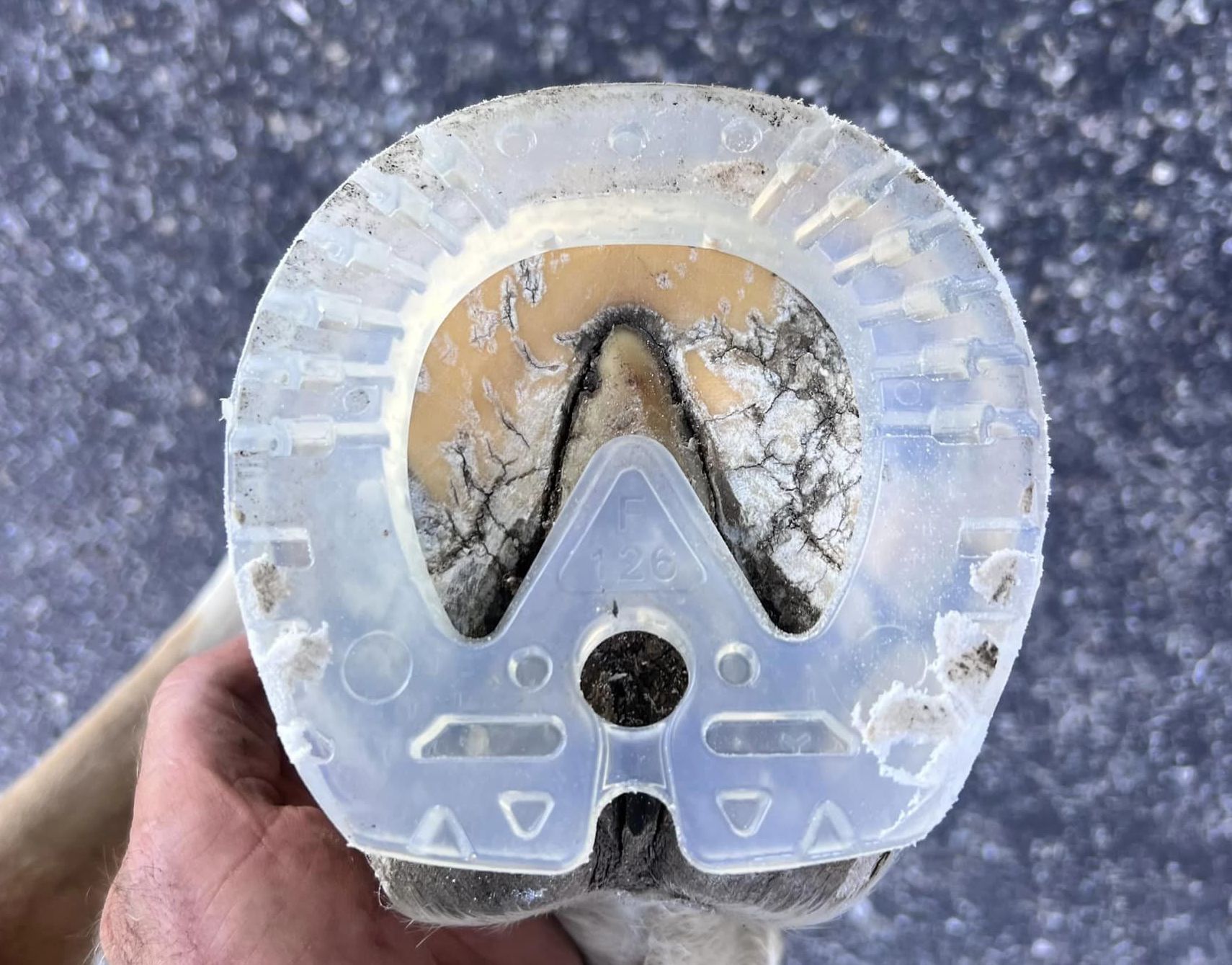
Excitement for the EasyShoe has been overwhelming.  Testing is validating our theories that this flexible device moves with the hoof and allows the heel to flex both vertically and horizontally. The first horse to wear them in a 50-mile race not only won the race but also received the best condition award.  Another endurance/trail horse in Colorado spent ten weeks in the EasyShoe with no ill effects to the hoof.  Ernest Woodward of the So-Cal Equine Podiatry Center, and the May 2013 EasyCare Dealer of the Month, is seeing positive results on a dressage horse. 

Dressage in the EasyShoe

I was personally responsible for the ten-week test on my horse named TNT.   Yes, ten weeks.  And yes, I'm fully aware that ten weeks is way too long, but we need to see if there are any ill effects from extended use. Many times I ask my personal horses to go above and beyond in order to collect data for the horses that will follow.  I would much rather resolve issues with my personal horses and make corrections before offering products to the public. 

TNT immediately after removing the 10 week EasyShoes and getting a fresh trim. 

With the EasyShoe being new we are looking at many areas including:

  1. Will the horse be hoof sore when the shoes are removed? 
  2. Will extended use cause the adhesive bond to fail? 
  3. How will the EasyShoe work as a transition device to take a horse from steel shoes to barefoot? 
  4. Will the vertical and horizontal movement heel movement allowed in an EasyShoe strengthen and build the internal structures of the hoof?
  5. Will there be evidence of the heels contracting or expanding with time?
  6. How will the shoes wear over a ten-week period?
  7. What are the best methods for removal and how will the adhesive bond be after ten weeks? 
  8. Does the device fill a gap in the industry?  Are there reasons for an equine professional to use the EasyShoe? 

After ten weeks in the EasyShoe and a quick trip to the round pen.

After ten I didn't know how strong the bond would be.  Would there be much left holding the shoe in place?  The video below shows my first failed attempt to remove an EasyShoe.  I didn't expect the bond between the cuffs and the hoof wall to be so secure.

Removal with pulloffs.  Fail. 

As you can see from the video above the bond between the hoof wall and the cuff was still very secure.  In the video below, I try another method and try and break the bond between the cuff and hoof with a large flat screw driver. 


Removal with flat screwdriver.  Success but not ideal. 

Although the screwdriver technique worked, it's not the easy removal solution I'm looking for.  My next attempt and the video below shows how I removed the cuff with a rasp. 

Removal success. 

The EasyShoe is looking good and we are pushing all other size molds forward.  We expect to be able to offer product to the public in a variety of sizes by early August, 2013.  Updates and news will be posted in EasyCare Newsletters and the Easyboot Facebook page. 

Garrett Ford

easycare-president-ceo-garrett-ford

President & CEO

I have been President and CEO of EasyCare since 1993. My first area of focus for the company is in product development, and my goal is to design the perfect hoof boot for the barefoot horse.


Don't Be Negative

Wednesday, May 1, 2013 by Guest HCP

We all know that being negative is considered a bad thing, and it's no different for the horse's hoof!
 
A negative palmar (front), or negative plantar (hind), angle in the hoof refers to the orientation of the coffin bone in the hoof. In a negative angled hoof, the wings of the coffin bone (called the palmar processes) are lower than the front of the coffin bone. A healthy hoof alignment within the capsule is considered to be a couple to several degrees positive. The range of normal can depend on the horse's individual conformation and breed. While there are proponents of a ground parallel coffin bone when the horse is at rest/standing on flat ground, it is generally accepted that the healthiest and soundest feet are those with a positive angle (this is my preference). As I am always repeating, the rear most area of the hoof is meant to be landed upon, and under full load it will dip downward as nature intended. If the hoof is already at ground parallel just standing still, the coffin bone will go negative under full impact.

A negative plantar angle.  The red line shows the angle we are referring to - the rear
of the coffin bone is lower than the front. This is an extreme example to help you see it.

So what are the causes, why is it bad, how do you recognize it, can we fix it?

Some of the causes of negative palmar/plantar angles:

  1. Environment
    One of the causes of negative palmar/plantar angles (NPA) relates to our arid environment here in Southern, CA. Without moisture to soften and help exfoliate their feet, some horses can build excessive sole. Bar material that should end about 1/2 way down the frog can migrate forward and over the sole, blending with the sole and even covering it completely. You may have heard the term "false sole" and this is what it is referring to. This material, if not recognized and removed, can pack in under the tip of the coffin bone and essentially push the edge upwards.
  2. Trimming
    Some horses are trimmed and shod to exacerbate this situation. Reiners, for example, can have crushed heels and excessive vertical toe height (NPA's) from sliding, and I see it in upper level dressage horses who are stepping under themselves during highly collected movement.  
  3. Conformation
    Sickle hocked horses are predisposed to this hoof form. Horses with DSLD are as well, because the damaged, dropping pastern and suspensory areas move the weight bearing area too far rearward.  

Why is being negative a bad thing?

The horse is essentially overloading the rear of the hoof. The soft tissues of the digital cushion, lateral cartilages, frog, etc., are being crushed. The heel bulb areas will look flattened, the frog can appear to be prolapsed, and there may be a crevice in the frog from where it is pinching forward (which can trap thrush). Horses with negative plantar angles often stand underneath themselves, which leads to soreness through the stifles, hocks, hamstrings and up into the croup and sacroiliac area.

How does one recognize this situation?

A lateral radiograph will certainly show you the bone orientation, and is ideal so you know exactly what you are dealing with. With that said, a big sign of NPAs can be a bullnosed appearance to the hoof wall. This is due to the wall following over the tip of the coffin bone which is pushing outward. Another obvious sign is from underneath the hoof, there will be more depth at the apex of the frog than the rear of the foot. Sometimes horses with NPA's will have wear such as squaring at the toe wall and a buffed appearance to the wall. (This is also a sign of sore hocks or stifles, which we know is a possible result of NPA's, but it can also be just a symptom of soreness, injury or weakness there and can't be assumed on its own to mean the horse has NPAs.)

Before (left): The bullnosed or dubbed shape common in horses that have a NPA.
After (right): Five weeks later - the heel was able to start lifting now that the pressure has been relieved.

 
How do you fix it?

After all that lead up, it seems over simplified to say you usually just remove excess sole under the coffin bone...but that is usually all that is required!  It may take a single good trim to fix the situation and get the hooves back on track. Or, more commonly, it can take many trims with varying amounts of material taken out, and the horse may need some remedial body work to help soothe the sore soft tissues. It takes someone really good at reading the hoof to know how much to take and when. Hooves adapt over time, and the corium that covers the coffin bone can actually have distorted enough that a trimmer could get into trouble by trying to over correct a situation too quickly. Sometimes all we can do is lower the wall at the toe, and only the sole immediately adjacent to it. If the problem didn't originate in the hooves but rather from a conformational issue, disease or an injury, we are limited in how much permanent change we can make at the hoof.  
 
At the AHA conference a couple of years ago, we used a simple heat sensing tool on the feet of horses that were NPA, before and after their trims. The feet were warmer after the trim, indicating possible better circulation in the foot when the rear of it was not being as crushed. I've seen some amazing changes to the heel and frog areas on horses with corrected angles so don't be negative, be positive!

A sole view of what changes can take place when correcting a NPA. There is approximately
6 months time between the images. The weight bearing area of the heel has moved back
and thickened, the frogs have widened, the hoof is rounder in shape, and there is more
equal depth under the coffin bone.  (The horse is a working teenaged dressage horse.)


Submitted by Sossity Gargiulo, Wild Hearts Hoof Care

Broken Down May Not Be So Broken

Wednesday, May 1, 2013 by Daisy Bicking

As hoof care providers we often get calls to help horses as a last-ditch effort before euthanasia. The owner calls with a laundry list of problems and a history of solutions that have been tried and fallen short.  

This is the case of a 19-year-old Quarter Horse gelding whose laundry list was a mile long. He had been diagnosed with:

  • bowed right front tendon
  • left front coffin bone fracture
  • sidebone
  • ringbone

His current diagnosis was navicular disease. When I first saw him he was barely walking on his left front leg. Many options had been tried to resolve his lameness but with minimal long term success. The owner was tired of watching him in pain and was considering euthanasia. The veterinarian who referred me to the case told the owner "Call Daisy, she may be able to perform a miracle for you"...no pressure!   

Anytime I come across a horse with arthritic conditions, navicular, etc my goals as a farrier are to minimize the range of motion the joints have to articulate through, hopefully minimizing the impact any soft tissue problems or rough bone surfaces may have as the horse moves. The more compact the foot, the shorter the distance the joints have to move in locomotion.

I have discussed my basic trimming and shoeing goals in previous blogs. The same goals apply in this situation as the other case studies I have highlighted.

My goals are:

  • 3-8 degree palmar P3 angle: the angle of the bottom of the coffin bone in relation to the ground.
  • 50/50 base of support from toe to heel around the center of rotation of the hoof capsule.

Here is the horse's left front foot when I came to see him:

Goal:
P3 Palmar Angle: 3-8 degrees
Toe Support % (50/50) 50% toe

May 8th Old Shoe:
P3 Palmar Angle: NEGATIVE -1.70 degrees
Toe Support % (50/50) 59.17% toe

I really respect what the previous farrier was doing with this horse. The shoe is well fit, and the rolled toe was working to help this horse with his lameness issue. However the internal and external hoof alignment was not quite to my parameters, so I felt increasing the palmar P3 angle and getting closer to a true 50/50 support base would have a good chance at helping this horse become more comfortable if not sound.  

Here is the same foot, same day, with the shoe pulled:

May 8th No Shoe:
P3 Palmar Angle: NEGATIVE -3.69 degrees
Toe Support % (50/50) 63.51% toe

So without the shoe the hoof capsule and internal alignment was worse.  

Here is what we were able to do in our first trim the same day:


Goal:

P3 Palmar Angle: 3-8 degrees

Toe Support % (50/50) 50% toe


May 8th After Trim:

P3 Palmar Angle: POSITIVE 2.90 degrees

Toe Support % (50/50) 56.70% toe


So we were getting much closer to our ideal parameters. I felt I had pushed this foot as much as possible at this time. We left him barefoot in a dry lot paddock. The horse became much more comfortable and at a walk was sound. But at a trot, especially on firm ground or on turns he was still off.  


I felt I had achieved as much improvement as I could achieve in his internal and external hoof alignment through trimming. I wondered if he even could become sound at the trot and on turns, especially on hard ground. We decided to use leverage testing to determine where his discomfort was coming from. An easy way to do leverage testing is with the KrossCheck leverage testing system:


The leverage testing revealed that the horse hated his toe elevated (functionally decreasing his palmar P3 angle) and was very happy with additional heel elevation (increasing the palmar P3 angle) which made a lot of sense. However, it was interesting to find that he also hated his foot being tipped from side to side, medial/lateral. I decided to try a glue on shoe to create ease of range of motion from side to side as well as add a bit more heel height.  


Here is what his foot looked like with the addition of the composite shoe:


June 14th New Composite Shoe:

P3 Palmar Angle: POSITIVE 5.74 degrees

Toe Support % (50/50) 50.20% toe


With the additional mechanics created in the shoe, and the shock dampening effect of the plastic, this horse went completely sound and is now back in work being ridden for trail riding, light dressage lessons, and some therapeutic riding five days a week. The leverage testing was an invaluable tool in getting this horse, with his laundry list of problems, back in work and sound. Here is his very happy owner enjoying her horse!  


Daisy Bicking, APF

www.DaisyHavenFarm.com