

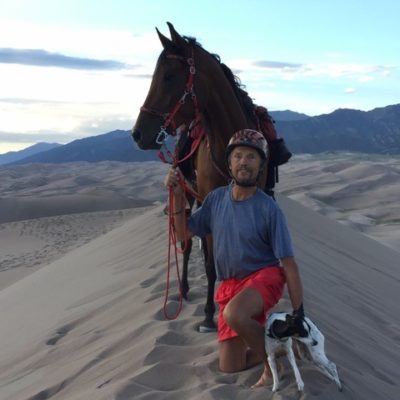
Introducing Christoph Schork, The Bootmeister

I rode my first horse at the age of 3 years in Germany. Since then, I spent a good portion of my life around horses. Dressage, jumping, Ride and Tie and for the last 25 years competing in Endurance on a national and international level and starting for the USA Endurance Squad in World Championships.

Together with my partner, Dian Woodward, we own and operate the Global Endurance Training Center in Moab, Utah, where we train over 40 horses. I have been working as a professional farrier for over 20 years, and have experience in shoeing and trimming. Over the years, I have been using steel shoes, Aluminum shoes, Equiflex shoes and Easyboots, but also training our horses barefoot for long stretches of the year.

With the recent revolutionary development of the Easyboot Glue-ons and Gloves, bare foot trimming is much more on the mind of horse owners and riders. The changes we have been seeing in horses hooves through usage of the new boots and at the same time allowing horses to be ridden and trained bare for extended periods of time, are astounding. I want to share some of my experiences with you and give some tips for trimming, booting and training.

My motto is: 'success through learning'.
 
www.globalendurance.com

dwcsarabs@frontiernet.net

Come In From the Cold

Monday, January 30, 2012 by Christoph Schork
Where did you spend last night? On or in the truck, trailer, the tack room where the heater went out?

fe

Will the boots stay on in snow and mud if you use cold or frozen glue?

sn

As the competition season for many riders gets slowly going, some riders are considering gluing Easyboots on their horse's hooves.  With frigid temperatures still prevailing in many parts of the country, successful gluing will depend on thorough preparation of Glue-On Horse Shoes and hoof glue.

After  many mistakes made by myself and after trying many different gluing methods, what proved to be the most successful method is a combination of VETTEC ADHERE or SOLE-GUARD for the sidewall of the boots and Goober Glue (or similar glue) for the bottom or sole area.

ADse
All these glues work best when used at room temperature. Goober Glue will get stiffer at cold temperatures and might not come out of the tube. Same with all the VETTEC glues.

When Vettec glues are exposed to sub freezing temperatures, it will not destroy them, but one should refrain from heating them up too quickly. Best to slowly warm them up to room temperature. ADHERE will thicken a lot below 60 F. Best temperature for Adhere is between F 65 and 85 degrees. Sole-Guard is generally thinner. At cooler temperatures it might be better to use Sole-Guard. Its gluing characteristics are similar to the Adhere but it runs thinner. The cooler the glue, the slower the setting times.

During the winter months we need to take special care to thoroughly dry the hooves before gluing.

If the boots are cold, warming them up will make them more pliable and easier to slide onto the hooves. The glue will also stick a lot better to them.

boot

After applying the Goober Glue to the bottom of the boot, we evenly spread the Vettec Glue to the side of the boot, but only to the top half. When sliding the boot then onto the hoof, the glue will then spread evenly over the whole side wall. Applying too much glue to the walls or too low towards the bottom and you run the risk of pushing some Vettec Glue to the sole area, which in turn could cause pressure on thin soled and tender  hooves.

hh

Apply the Vettec glue just to the top half of the boots side wall. In the sole (frog) area the Goober Glue is already added. Like we stated many times, success in gluing comes from proper preparation of hooves, boots and glue.

Cleanliness and dryness are the secret to success. Then the boots will stay on for weeks without doing any harm to your horses hooves and without falling off in the middle of a ride or race. During the winter months, we add the third ingredient, which is warmth.

At the Global Endurance Training Center we are gluing on EasyCare Glue ons and Glue-On horse shoes all year long. And we are using hoof glues in all kinds of weather and temperatures. It is taking a some effort to pry them off after wards. That is how it is supposed to be. Clean, dry and warm are the magic words.

ddd

This boot will stay on no matter what the elements are.

Good luck with gluing.

Your Bootmeister

5 Ways To Sharpen Your Knife

Monday, January 16, 2012 by Christoph Schork
Sliced or squished, how do you like it?

Dull knives are dangerous, no matter how you slice it! Whether cutting vegetables, bread, meat or trimming hooves, you need to use a lot of strength. A dull instrument can bounce and deflect, causing bloody hands for the operator. Sharp knives can be controlled with minimum force: they do their intended job with ease. For natural hoof trimming and barefoot trimming, a sharp hoof knife is a must. Dirt, sand and mud left on the bottom of the hoof will quickly dull any hoof knife.

An often heard question at the different natural hoof care clinics has been "which is the best way to sharpen hoof knives?"

Below a list of some of the most common sharpening devices.

1. Bench Sander
Bench sanders and grinders can be used for many purposes and they work great for sharpening knives. They are more cumbersome to haul around and require electricity.

bench sander
sander

The blade should always get sharpened from the inside (the rounded side) only.

Advantages: fast results, the spinning wheel does the work.

Disadvantages: difficult to sharpen the curved tip; easy to tilt the knife blade, resulting in an uneven blade. A very skilled and delicate touch is required. Doesn't work for Loop Knives.

2. Diamond Sharpener

Always sharpen from the curved side only. You can pull the sharpener towards you or turn the knife around and push the sharpener away from you, as the two images below show.

diamond diamond2

Advantages: easy to use, forgiving, curved tip can get sharpened as well.

Disadvantages: requires more strokes to achieve a sharp knife.

3. Chainsaw Sharpener
Normally used to sharpen the links of chain saws; a good tool for hoof knives as well.

chain

Again, you can pull or push the instrument. As you can see, it fits nicely into the curved tip.

Advantages: works fast, you achieve a nice sharp tip.

Disadvantages: It is easy to dent the blade if not careful. The round file, especially when new and sharp, can cause some waves in the blade when not being worked diligently.

4. Swissistor
This tool was specifically developed for sharpening hoof knives.

swististor

Advantages: easy and fast results.

Disadvantages: tightly curved tips and loop knives can be difficult to sharpen evenly.

5. Sharpening Stone
The oldest knife sharpening tool. Works best when wetted with water.

st

Advantages: ease of use, safe.

Disadvantages: often hard to get the tip sharpened.

After sharpening the curved side of the knife, it is necessary to deburr the flat side of the knife. The stone is most suitable for that task.

de

Best sharpening results are achieved by holding a 30 degree angle between the blade and the instrument. For deburring, a 10 to 20 degree angle works well. You can now move the blade  towards you with a light slicing movement.

When sharpening the knife, it is best to hold the knife still and move the sharpening tool across the blade. When deburring, you hold the stone still and move the knife across the stone.

Here they are all together one more time, for size comparison:

adf

What is my favorite sharpening device? The Swissistor.

A sharp hoof knife makes the job of horse hoof trimming a lot easier.

Your Bootmeister

Natural Hoof Care in Europe

Monday, December 5, 2011 by Christoph Schork
Dresden, a pearl a the river Elbe in Germany, was the first stop of a 4 week Hoof Care Tour last month conducted by me, The Bootmeister from Global Endurance Training Center.

I have been going to Europe now for the last two years, sharing some gained hoof care and hoof protection Knowledge with riders, horse owners and farriers. The demand for more knowledge is high, people are eager to learn about Natural Hoof Care and the newest  Hoof Protection products on the market. EasyCare is the undisputed leader in the world with research and development of hoof boots of all kinds. R&D is of utmost importance to the EasyCare staff. Horse owners worldwide know that. Hence, it is only logical, that EasyCare boots stood in the lime light of my presentations.

Dresden

View from the Frauenkirche over the Castle and the Elbe.

After an indoor anatomy session and PowerPoint presentation, the 20 participants had ample opportunity to train their eyes during conformation analysis sessions and study first hand how conformation affects hoof growth. Afterward, the riders who brought their own horses, in total over 10, could practice mapping out the sole and rasping the hooves of their horses. I placed a lot of emphasis on developing the skill of reading the sole. Aspiring hoof trimmers generally fare well when following the principle of trimming a hoof no further than to the live sole. It is a safe approach and everybody can learn it quickly.

The second day was devoted to Hoof boot selection and application. I explained and demonstrated the usage of Easyboot Edge, Trail, Glove and Glue-On and afterwards everybody could practice. It is important to actually do things. We humans all learn most by doing, we easily forget when just watching and listening.

Gluing

Demonstrating the use of Vettec Glue gun and application of Adhere to the Glue on shells.

Glue on

Finished gluing job.


Coaches in downtown

These coaches in downtown Dresden provide visitors a feeling of stepping back in time. After looking at the hoof protection of these carriage horses, we all agreed that they would travel  much more comfortably with Easyboots.

Coaches

Next stop was Hannover. Well known for the Hanoverian breed, this city has a long horse tradition.

The on-site organizing committee had invited over 45 Hoof Trimmers, farriers and veterinarians. After my initial presentation about the different Natural Hoof Care schools and philosophies in the USA and Europe, we discussed NHC and trimming techniques as well as hoof pathologies and remedies. I presented the thesis and studies of Dr. Brian Hampson of Australia, who did the most thorough studies on the hooves of wild horses so far.

If someone were to conduct a study, for example, on the hooves of one herd of wild horses  in Nevada or Utah, the two driest states within the USA, where horses have to travel many miles over rocks and sand to find water and food and then propose to use that feral hoof as a benchmark model for healthy hooves for all domestic horses in the world, would that be a realistic and fair conclusion?

Hampson studied and examined hooves from various areas in Australia,  wild horses living in arid areas and others in wet areas with lush vegetation. The hooves of the wild horses living in the wetter areas looked a lot like the average domestic hooves. Does that mean the hooves adapt to the environment or are the hooves shaped by the substrate the horse travels over?

An answer to this question might be obtained by looking at the following photos, provided by Brian Hampson.

Hampson

explanation

The left hoof has the appearance of a typical domestic hoof. Recessed frog, under-run heels, flares. Yet, it is a wild horse hoof. After moving several horses with these hooves to a different (drier) area, the hooves were remodeled by the ground the horses traveled over. The hoof on the left is void of any mustang roll. Does it not need it? Within 16 weeks the rocks and dry ground reshaped that very same hoof. The mustang roll is clearly visible now. The question might be asked, how important is the mustang roll then, when we as natural hoof care trimmers applying it to all horses, yet only a small segment of wild horses worldwide even display one in the wild?

The study also showed that only three hooves out of 100 assessed were free of abnormalities. In fact, he found a 67% incidence of chronic laminitis within the horses living in the dry climate and the hard substrate. When the majority of the wild horses display this pathology, is it still a pathology or is it physiologically normal now? Who makes these decisions?

Not everything wild is necessarily good solely because it is wild and natural. The wild horse paradigm model of desert horses' hooves may not be applicable across the board to all horses worldwide.

The discussions were very interesting and we were only scratching the surface of all the ramifications of the Hampson study.

Hannover

Discussions of Natural Hoof Care in Hannover.

On I went to Kassel, stop for the next seminar. 

Similar to the USA, Germany experiences also a shortage of farriers who are willing to offer services beyond the traditional iron shoes. Many do not know about bare hoof trimming and alternate hoof protection like plastic shoes and hoof boots. Therefore, more and more riders and horse owners want to learn to trim their horses' hooves themselves.

I set up several stations, where people could work on their horses hooves simultaneously. That way, everybody had ample time to practice and learn.

kassel

Working at stations.

Onwards to Belgium. near Brussels, I conducted the last clinic. My French is very rusty, to say the least, so everything was translated by Leonard Liesens, a famous and successful Belgian endurance rider.
I learned to speak slowly and to include only essential information in my sentences. And I got my message across as well, without lengthy and repetitive wording. An exercise in disciplining speech.

brussel

The historic Market Place in Brussels.

leonard

Leonard Liesens checking the fit of the Easyboot Glove he had just applied.

At all the seminars, I also showed slides of the Tevis ride. With all the Europeans now coming to the Tevis next year, we better all put our entries in early to avoid being placed on the waiting list.

The Europeans were all very eager to learn and try new trimming techniques. They are pragmatic and want to use the trimming and hoof protection that works best for their horses. They do not believe that Natural Hoof Care and Bare Hoof Trimming is an ideology or a mantra. For them, it is not an absolute, rather a better and healthier way to take care of their horses' hooves. They do not want to listen to self righteous statements of cult-like organizations. The welfare of their horses is important. That is a reason why Pete Ramey stands in such high esteem in Europe, his open mindedness, his tolerance, his knowledge and non judgmental approach to hoof care puts him in a class of his own and a big step above everybody else.

I did stress the importance of looking at each horse as an individual. The trimming procedure that works for one horse, might not be the best approach for the horse right next to it.

Europe has many more horses than the USA. Per capita, Germany has 70% more horses than the USA. Horse owners and riders want to learn and improve and use modern and better hoof protection methods.
Already now, I have booked several more clinics for next spring, this time in addition to Germany also in France and Switzerland. Natural Hoof Care, Barefoot Trimming and Easyboots are on a roll and gaining ground and popularity throughout the whole equestrian world.

August

Golden statue of August Der Starke (August The Strong), former King of Saxonia, in Dresden.

A special Thank You goes out to my liasons and support persons who organized the events on site. Without them, it would have been very difficult to impossible to conduct the seminars:

Dresden:     Veit Koppe

Hannover:   Patricia Nastoll and Kathrin Ewen

Kassel:        Martin Boesel

Brussel:       Leonard Liesens


The Bootmeister, reporting from Europe


Managing the Club Hoof

Tuesday, September 20, 2011 by Christoph Schork
Many articles have been written about club 'footed' horses. Actually, horse do not have 'feet', dogs and humans do, but horses have hooves. Therefore the term 'barefoot', as much as it is in common use now, really is a misnomer. When we ride without hoof protection, we ride 'bare hoof'. Ah well, a pet peeve of mine!

Today, I want to give an overview for the reasons club hooves occur and how we can manage and improve on the situation.

Dr. Redden's classification of club hooves:

Club hoof by Dr. Redden

While Grade 3 and 4 are extreme and the horses are most likely very lame, Grade 2 and 3 are not that uncommon. I will mostly focus on these two grades.

How do these club hooves happen or develop?

First we do have the genetic club hoof, the foal is born with it, where P3 is out of alignment with P2 and P1 and displays a steeper angle. This can only be observed on a radiograph.

Radiographs

Clearly visible on the first image: the dished dorsal hoof wall and  P3 is rotated downward and has a steeper angle compared to P1 and P2. These genetic downward rotation is very hard to overcome and correct.

Other causes for club hooves:

- Excessive pawing and consequently deep flexor tendon shortening

Already in the 1,800s, German farriers observed foals developing "Stelzhuf" during dry years or when kept in stalls and pawing for hours. The unpressured heels grew excessively and the toes developed dishes dorsally. Allowing plenty of pasture and space to roam, will help fixing this unhealthy habit in foals, that sometimes is also observable in adult horses.

-Epiphysitis

Occurring in young foals, when the long bones grow faster than the tendons. The tendons cannot keep up with that growth, thus getting very tight and not allowing to flex when the foal tries to step forward. Less weight over the heels will make the heel grow excessively and the deep digital flexor tendon is pulling the wings of P3 upward, thus rotating the tip of P3 downward. Often caused by too much protein intake. This is a case where your veterinarian can advise you best.

-Suprascapular nerve damage

The muscles that hold the scapula close to the body have a suprascapular nerve. Sometimes, when the horses leg gives out when bearing weight, this nerve can get damaged, thus impeding proper muscle movements. The stride is shortened, thus again, placing more weight over the toe and less pressure over the heel area on the affected side. Club hoof in the development. Veterinarians call this situation often 'Sweeney'.

-Muscle injuries and adhesions

The two muscles holding the scapula in place can get injured through jumping, riding fast or in a trot through dips in the trail, rough play in the pasture or by pinching and poorly fitted saddles. When these muscles are injured, often the horse is unwilling to extend the affected shoulder and leg, again resulting in shortened strides and toe landings with decreased heel pressure, resulting in the excessive heel growth.

-High/Low syndrome

Grazing horses, especially long legged horses with short necks can develop an habitual club hoof. The same hoof will always be forward and the other back. The back hoof will get pressure on the toe, developing a dorsal dish, the heels are mostly unpressured, growing faster than the toe.

High low

This horse is habitually placing the right front back when eating/grazing close to the ground, thus developing a grade one (by Dr. Redden classification) club hoof.

Correctional measurements: feed higher above the ground.

All these conditions can get improved through careful stretching forward of the affected limb and massaging the groove between the body and the scapula. Below some images of massaging this area.

start

Here I start to gently massage and opening up the muscles around the scapula. Everything is still tight.

getting deepber

Slowly getting deeper into the fissure.

side of hand

I switch using the side of my hand to open the space.

deeper

Further opening the space by applying more pressure with my sliding hand.

best
finish

By now, more than half my hand disappears beneath the scapula. I keep opening the gap more and more, till the adhesions are loosened and the muscles supple (3 to 5 minutes will often be sufficient).

Be gentle, watch the body language of the horse: if she leans into you, licks the lips, moves the head towards you, it will feel good and you are getting results. Massage oil will help opening the scapula and relax your horse.

Training considerations:

When training a horse with a club hoof, make sure the saddle fits properly without pinching the shoulders. Focus on balanced riding. When posting in a trot, post on the clubbed side most of the time. When cantering, lead with the clubbed side. Work cantering circles with the club hoof on the inside, walk and trot circles with the clubbed hoof on the outside.

Trimming considerations:

Guard against the temptation to just cut the heels down to match the 'normal' side. When over trimming into live sole in the heel area, the hoof will respond quickly by growing even more sole thickness back, and that rather quickly. Furthermore, by thinning the sole, the lateral cartilages sink downward, thus raising the heels from within. By lowering the heels too much, the deep flexor tendon can get stretched and stressed too much, causing injury.

Mapping the sole will tell you how much to trim. Exfoliate the dead sole just to the live sole, but no further. No matter how high the heel is and how clubby the hoof looks. Leave the hoof wall and bars about 1/16 to 1/8 of an inch longer than the heel. Keep the sole callous area on the toe, bevel the hoof wall and allow the flare to grow out. Trim a little often,  in a one or two week interval. Just remove the chalky dead sole and shorten the heels to the above mentioned length. With proper management, care, massage, training and feeding regimen and riding bare, the club hoof might just normalize surprisingly fast.

Below an example of a clubby hoof and the change that occurred within 5 months:

LPZ

Notice the big dish on this habitual club hoof.

4months

5 months later, the dish is greatly diminished, (notice that I did not rasp the dorsal hoof wall at all for this picture),  the hoof expanded and is now almost the same size as the 'normal' left hoof.

both

These are visible results, that proper trimming and management can succeed.

Protective Horse Boot considerations:

Barefoot Trimming, Natural Hoof Care, Bare hoof riding will all contribute to success. When selecting Easyboot Gloves, it is advisable to use powerstraps, especially if you have any dorsal hoof wall flares present.

strap

This Easyboot Glove with Powerstrap was adjusted to the first image of the flared hoof photographed above. We do see a good and close fit on the hoof wall.

A few layers of athletic tape worked in this case as well.

Athletic

When trotting horses with one club hoof, inevitably the sound of the hooves hitting the ground will differ from left to right. The clubbed hoofed leg will also not extend as far forward as the normal leg. This causes the trot to be somewhat uneven. Endurance riders know the importance of a sound horse that  leaves no question mark. Even more an incentive to manage and improve the club hooves.

Your Bootmeister

From the Global Endurance Training Center in Moab


A Hoof Perspective: AERC and AHA National Championship 2011

Thursday, September 1, 2011 by Christoph Schork
Fort Stanton in New Mexico hosted the 2011 AERC National Championships.

Running from Death

The Bootmeister riding past the famous Fort Stanton Cemetery during the 100 mile Championship race.

For many years, Roger Taylor had hosted a 6 day pioneer endurance ride in this central area of New Mexico. Rich in history with a great scenery and plenty of sightseeing and exploration possibilities, Lincoln county has lots  to offer.

This year's entries were down. Some blame it on the economy or high fuel prices, but the competing riders were rewarded with great weather, an outstanding veterinary staff and excellent management. Adequan was a major sponsor and helped make this event possible. Abundant rain this summer made the countryside very lush and green.

Trail

With over 17,000 vertical ft of elevation gain in the 100 mile race (and an equal amount of elevation loss), this championship ride featured more altitude climbing than Big Horn (15,500 ft) and Tevis. With temperatures topping out in the 90s, a good amount of humidity and a total mileage of 105, the 2011 AERC National Championship turned out to be one of the toughest in recent memory. New Mexico also has no shortage of rocks, so a very high percentage of riders elected to ride in protective horse boots with the overwhelming majority choosing Easyboot Glue-On hoof boots or the Easyboot Glove. It certainly seemed to be the right choice of hoof care products when looking at placings, finishing times and completion ratios.

Climbs

Here we see Christoph Schork on one of the many uphill climbs on Stars Aflame.

Finish

Finally, after a very long day that started at 4 am, Stars Aflame and Christoph arrive at the finish line.

Bev

Beverly Gray from Utah finishes in 2nd place. She rode the last loops with Tennessee Mahoney from Colorado, who finished in 3rd place.

Maybe it is not a coincidence that 50% of the top ten horses in the 100 mile championship race used protective horse boots from EasyCare. The Bootmeister won the 100 mile event and received the Best Condition award. Other EasyCare booted riders in the 100 mile event were Tennessee Mahoney, Rusty Toth, Leah Cain McCombs and Scott Campbell. In the 55 mile event, Tennessee Mahoney won the Half Arabian AHA 55 Championship ride. JJ Donelly finished in 3rd place and won the Junior Division, also winning the Best Condition award. He rode in Easyboot Gloves. These are just a few names of all the finishing riders at the championships equipped with EasyCare boots.

BC trotting

Stars Aflame and Christoph

Trotting circles for the BC judging, Christoph with Stars Aflame, National 100 mile Champion, National 100 mile AHA Champion, 2010 AERC War Mare. Stars Aflame won the Best Condition Award.

Awards

Christoph at the Awards ceremony.

trophy

The question is: would I have received this trophy without using the Easyboot Glue-Ons?

A big thank you goes out to Roger and Sue Taylor for organizing such a challenging event, Linda Sherrill and Justus Photography.

From Ft Stanton reporting: The Bootmeister.

The EasyCare System

Tuesday, August 2, 2011 by Christoph Schork
In the Moab area, we are lucky to have an abundance of sand on our trails. We can easily ride barefooted on most of our training and conditioning rides There are stretches of rocks, no doubt, we might slow down or, if the rocky stretches are extensive, use the Easyboot Gloves which we always have in our saddle pack. But we all know, it only takes one rock being at the wrong place at the wrong time, maybe even with a nasty sharp point sticking up and 'hello stone bruise'.

Riding in sand

You do not always know you just got hit, sometimes nothing happens for days with the hoof. As was the case with our stallion, DWA Express. After riding him for weeks bare, I was getting him ready for an endurance ride, applying Easyboot Glue-Ons. Hooves look good, no bruising detectable; if you read my previous post, I took diligent care to clean and dry the hoof thoroughly, but nothing seemed to be out of the ordinary. When trimming and before booting, I leave the callous sole mostly intact, sometimes even some dead sole, if it is still attached and not flaky. I did not use a hoof tester, there was no reason for it by the looks of the hooves and DWA Express showed no sign of any lameness whatsoever.

Test riding Express after applying Glue-Ons, he was lame after three miles. When something goes wrong with airplanes, pilots are trained to always undo the last thing they did before the trouble occurred. I did not follow that old pilot rule, did not want to pull the brand new boots off, because I had not seen anything wrong with the hooves in the first place. It was easier to assume a muscle pull or some unexplained oddity, especially after Express improved within a couple of days.

Eventually, though, time comes to pull the boots:
Bruise

After removing flaky sole, a bloody cavity opened up. I had to dig deeper and open it up to make sure there was nothing embedded and investigate the extent of the damage. New sole had already grown beneath, that's why the horse had stayed sound. Backtracking the events, when initially the glue on boots were applied (with Goober Glue at the sole and Adhere at the hoof wall), there was just enough pressure exerted onto the sole that the horse came up lame. But somehow, that pressure then dissipated enough within a couple of days that Express traveled sound again.

Pulling out the EasySoaker, adding some water with Epsom salt to draw out any bruising, then following up with a Betadine/sugar soaking solution.

EasySoaker

Below hoof after the soak with the betadine solution:

soaked hoof

Next, application of a pine tar hoof packing, for good measure, I cover just about the whole bottom of the hoof.

packing hoof

Final Step, application of an Easyboot Glove for a few days, to prevent any contamination to enter the injury site.

Glove

While working on this hoof, it occurred to me that EasyCare doesn't just manufacture hoof boots of all kinds and for all uses, but really provides much, much more to the equestrian community. EasyCare has created a total hoof care system.

What is a 'system'?
Wikipedia defines a 'system' as a 'set of interacting or interdependent components, forming an integrated whole'. The Business Dictionary defines it as 'a set of detailed methods, procedures and routines established to carry out a specific activity, perform a duty or solve a problem'.

Isn't this precisely what EasyCare is providing? Looking through EasyCare website, we clearly see that system.

First, there is a product line of hoof boots and supporting hoof care/trimming equipment that is so extensive, that it allows users to take care of their horses hooves, no matter what discipline they are competing in, what breed of horse they are riding, what terrain they are riding. Hoof treatment boots and therapeutic applications, no problem, EasyCare has you covered.

The extensive product line of Protective Horse Boots and Hoof Care Products was built upon input from customers. After customers use the products, the educated feedback from users constantly improves and expands the product line. This interaction is based upon solid and encompassing education. Here, EasyCare is compiling a mountain of information, videos,  books, DVDs, from the best in the field, with Pete Ramey's research standing out above all. Newsletters, blogs from users and professionals, hoof care clinics and boot application clinics round out the extensive education program that is second to none. The education alone is a sub system in its own right.

It is all there, mostly just a mouse click away. Often I'm wondering, with so much information out there and easily accessible, why do we still see so many ill-fitting or lost boots out in the field? When failures happen, it becomes all too easy to blame the product for the failure instead of a faulty trim,  application method or own ignorance; it takes time and effort to get informed and educated, but the payback is huge.

EasyCare's success is built upon its system, let's take full advantage of it! Ill-fitting boots, rubbing boots or lost boots will then soon be a thing of the past.

Happy studying!

Your Bootmeister

What Have We Learned?

Monday, June 13, 2011 by Christoph Schork
Remember the good old times? I do have fond memories of foaming the Original Easyboots on horses' hooves. In the 80s and 90s, we often foamed. And what a mess it sometimes was. Very few of us still foam Easyboots nowadays. But for old times' sake and for this blog I decided to do it again. I also felt sorry for these boots sitting unused on the shelf. Most importantly, I wanted to see if I still can make a mess! You be the judge on that one.

z

Actually, it hasn't been all that long ago that we  quit foaming boots. But when protective horse boots developed in such a revolutionary way, it seemed that the foaming days were waning for sure. The EasyCare Glue-On boots have been used and tested now for over two years. We all have learned a lot and we are still learning to improve our application of the EasyBoot Glue-Ons.

Quite frankly, no hoof protection on the market has fascinated me as much as the glue-on horse hoof boots and the whole glue-on procedure. Just something about being a hoof care provider and chemist at the same time.

It's been over two years now since we started, cautiously, to glue on the first boots. It happened at a 3-day ride in December in Sonoita, Arizona; the start of a new ride season. Glue on horse boots were unheard of before then. Mistakes were made by us, we lost boots. I'll spare you from listing all the mistakes we made, we would only reinforce them. What I want to share with you are the improvements we made, the lessons we learned, so  you don't have to make the same mistakes we did.

Most Important Lessons We Learned
  1. The hoof has to be totally dry and totally clean.
  2. The glue-on hoof boot has to be dry and clean.
cleaning hoof
cleaning hoof

After using hoof picks, a wire brush, available in hardware stores, works great to clean the hoof. Notice how clean this hoof is, all dust, sand and dirt are absent. A white line separation was treated with iodine. 

Drying can be accomplished with a heat gun. It will work the best. Thoroughly dry the hoof wall and the sole. If you do not have a heat gun available, a hair dryer will do as well, it just requires more time, because it provides less heat.

When the hooves are wet, dry the walls and soles several times. Capillary action will move moisture back to the hoof wall after drying it the first time. Nature always tries to balance things, so when there is a lot of moisture in the hoof, like after a rainy weather period, drying the outer periphery of the hoof wall will make the remaining moisture inside the hoof move to the now dry areas through this capillary action. Therefore it is really important to take the time to dry the hoof several times.

o

Lately, we have been using Goober Glue for padding the bottom of the hoof. If using Goober Glue, the actual sole does not have to be quite as dry as when using Equipak. However, keep in mind that bacterias thrive on moisture. So, by drying the sole really well, you are also taking care of any bacterial infestation. Literally, with a heat gun you can actually burn  any fungi or bacterias. You do not have to worry about damage to the hoof. Farriers have hot seated steel shoes for centuries, the hooves can handle the heat for a short time without any damage.

o

Notice the slight brownish color in the quarter area. We actually seared the sole slightly and killed any detrimental bacterial infestation. Not to worry, the hoof can easily handle it, heat dries, hardens and disinfects the sole.

Boot Preparation
If the heel bulbs of your horse are fairly low, you can easily cut the back of your boot down. It will not compromise the structural integrity of the protective horse boot.

a

In cold weather, you may also use the heat gun to warm your boot up.

n

Once you have finished drying and cleaning the hoof and boot, you should only handle the hoof and glue on boot with gloves. EasyCare has gloves in their store, but you can also use simple latex gloves from the hardware store. This is of utmost importance, otherwise dirt, moisture and grease from your hands can easily contaminate the hoof wall and boot, thus compromising the adhesion of the Vettec Adhere.

Next, I like to apply Goober Glue to the bottom of the boot. Goober Glue remains very soft after drying and is a good cushioning for even tender footed horses. We apply the Goober Glue in the shape of the frog, more for hooves with deep concavity, less for flat footed horses. Goober Glue takes several hours to cure, so no rush with this application.

Vettec Adhere will work best for gluing the side walls of the boots onto the hoof.

Vettec gun

Here I'm applying the Adhere with the large 180 cc application gun.

Always hold the boot on its side, so the glue does not run down inside the shell to the bottom of the boot, possibly causing undue pressure on the sole. Adhere is a very dense material once it is set, we do not want it on the bottom of the boot.

s

The Goober Glue has been applied in the shape of the frog to the bottom of the boot, then the Vettec Adhere is applied only to the top half of the boot shell. When pushing the boot onto the hoof, the Adhere will then get pushed down the remainder of the boot wall, but not as far as the bottom of the boot.

g

Notice again how I hold the boot almost upside down, in order to prevent the Adhere from flowing to the bottom. In warm temperatures, it could easily happen.

g

You do not need a lot of glue, this is plenty. Pushing the boot onto the hoof will spread the glue down the remainder of the shell wall.

Working with Adhere, one has to move fast and expedient. Adhere sets within one minute. If you work too slow, the Adhere will have set before you get the boot onto the hoof. 

Just recently, Vettec brought a much small application kit on the market.

Vettec 50 cc kit

This kit is lightweight, has three mixing tips, a plunger with a finger ring. Easy to use, you can take this kit in your saddle bag, just in case you did not use good diligence at home when gluing and lost a boot. You can then easily re glue on the trail. Setting time in 1 minute, full cure in 5. Beats not finishing your ride because of a lost boot.

pushing

Again, tilt the boot while you apply the glue to the side wall, so it doesn't run onto the bottom of the boot.

sidetilt

One 50 cc tube holds enough glue for 4 glue-on boots. Contact me at Global Endurance Training Center if you would like more information about it. After pushing the boot onto the hoof, it is highly advisable to seal the edges with a beat of Adhere. With your gloved finger, you should then smooth it out. You want to create a good seal all around the shell between the hoof wall and frog, so no moisture and debris can enter the boot.

beat

Here using the 50 cc applicator, below the 180 cc applicator gun

h

After applying Adhere to the edge of the boot,  use your gloved finger to smooth it out.

k

In the frog/bulb area, some Goober glue will have pushed out. We smoothen it out to create a good seal there as well.

l

Now we have a complete seal around the edges of the boot.

A lot of questions have been asked regarding how long we safely can keep Easyboot Glue ons on our horse's hooves. As often, the answer is: it depends.

If you did a great job drying and cleaning your hoof, have no bacterial invasion, or you took care of it through drying and various remedies, (see our previous blogs on Hypozin and Sore No More), diligently sealed the edge of the glue on boot all they way around the hoof, then you can leave these boots on for up to a whole trimming cycle.

Below a couple of photos of boots glued on the hooves now for 5 weeks. Notice that the seal  is still intact. No foreign matter was able to enter these Glue on Horseshoes.

j

l

This horse did two 50 milers with these boots and over 100 miles of conditioning rides. All the seals are intact, no water, mud or sand was able to enter these boots.

Here are some more photos from different hooves after boot removal that had glue ons applied for about 6 weeks:

pulling boots

No thrush, no smell, no problems with this hoof. Residual glue still on the sole. After initial cleaning, glue removal and a slight trimming, (the trim is not completed) it looked like this:

initial trim

A photo of the hind hoof:

hind

What's remarkable here, no bacterial or fungal invasion and no white line separation anywhere.

After using EasyCare Glue ons now for over two years on most horses at GETC, the cases of white line separation have  almost completely disappeared. When keeping the Glue on boots on the hooves for the full trimming cycle, (up to 6 weeks), we observed a notable decrease of  white line separation.  Could it be, that the shell gives the hoof capsule more stability? Could it be that there is less bacterial invasion because the sole is clean and sealed? Could it be that there is less peripheral loading when traveling  with Easyboot Protective Horse Boots, thus weight bearing is more distributed over the whole foot instead of the hoof wall? Could it be, that we all are getting better at trimming? Or is it all of the above?

Whatever the answer, the results speak for themselves and they spell SUCCESS. We tried, practiced, learned and succeeded. 

Working with Glue ons and Hoof Glue is fun, it works and helps your horses hooves.

From the Global Endurance Center:

Your Bootmeister

"If the Glove Doesn't Fit, You Must...

Tuesday, May 31, 2011 by Christoph Schork
 c

...pick a smaller one!"

This Glove looks way too big. So we try next size smaller?

b


Measuring with a shell a half size smaller, in this case  size 0, this one does not accommodate the heels of the hoof.

....you must use then athletic tape":

c

This is better, but still not fitting right, no 'V' is displayed, where the hoof pick  points, we see a gap.

Looking at the naked trimmed hoof, we can see some serious dorsal hoof wall distortion. The dorsal hoof wall is already dressed back to the white line. This horse has a smaller foot on the right front, caused by genetics. Furthermore, this horse always pressures the dorsal hoof wall when standing, thus aggravating the distortion. That hoof does not have a stretched or torn laminae.

d

Clearly visible the dorsal distortion. This will make it difficult to select the proper size Glove. As mentioned, the length of the hoof does not allow a 0 size boot. Therefore the only solution left, 

...use a boot with a power strap!"

f

The same size boot, 0.5, that had that huge gap in the front, now encloses the hoof wall very nicely.

For hoof wall distortions like this one, when even your best efforts of horse hoof trimming and natural hoof trimming don't get you a hoof with straight sides, a Easyboot Glove powerstrap comes in very handy. They come in many colors, by the way, not just grey.

Natural hoof care and barefoot trimming will not always get you the desired results. Straight hoof walls are the goal, but not always achievable.

The left front hoof of the same horse looks different:

q

The hoof walls are straight all the way around, there are not even any flares that need to get dressed back; but to give the Glove a little tighter fit and prevent sand, dust and/or water to enter the boot, we use athletic tape and wrap it around the hoof. 

w

You can wrap the tape all the way across the heel bulbs. When then applying the Easyboot Glove, it helps if you have a hoof pick to ease the shell onto the hoof. If you just push it on, the tape can bulge up and the boot then won't fit right.

e

When using the tape, always use the rubber mallet to seat the boot. The tape will add a lot of friction.

y

While setting it down, gently pull on the gaiters, so you do not have any creases in the fabric and the heel bulb sits nicely in the gaiter pocket.

t

Close the velcro straps snugly.

Now we have a tight fitting Glove, displaying a nice V. If one needs an even tighter fit, or you just happen to be between sizes, one can wrap several layers of tape around the hoof wall. You want to see a V.

Before removing a boot, first lower the gaiter all the way down.

u


Next, gently break the friction created by the tape by loosening the shell at both sides at the quarters.

u


Never pull the boot off by the gaiter. Not only will you tear it, but you might cause damage to the horses fetlock.

After you pull your Easyboot Gloves off the horse's hooves, now is a good time to quickly tighten the screws that hold you gaiters to the shell. If you have used lock tite, then you would not need to do that. Many screws have been lost by riders forgetting this small, but important maintenance step.

From the Global Endurance Training Center in Moab, Utah

Your Bootmeister

The Bootmeister Invites You to an Upcoming Hoof Care Clinic

Wednesday, May 11, 2011 by Christoph Schork
A one day hoof care clinic will be organized and conducted by Global Endurance Training Center and the Bootmeister. This event will be in timely proximity to the Owyhee Fandango Pioneer Ride, a 3 day ride, a first class endurance event in Oreana, Idaho, on May 27th, 28th and 29th. A long time favorite for riders from all over the world, this is an event you do not want to miss. Besides the 3 Day Pioneer ride, the event will also feature a 80 and 100 mile ride.

Hoof Care Clinic Germany

Christoph Schork at a recent Huf Coach Clinic in Germany. 

The Hoof Care Clinic will take place Wednesday, May 25th, in Eagle, Idaho, very close to the Fandango ride and this presents an unique opportunity to attend both events in the same trip, a big consideration during this time of ever rising fuel prices.

This clinic will cover in detail the anatomy of the horses lower limbs and discuss various hoof trimming techniques. 

Global Endurance Training Center Presents:

Hoof care options for the competitive endurance horse

 Presentation, Discussion & Demonstration
 
When: Wednesday, May 25th, 2011
 
9 am – 5 pm
 
Where: ONCE UPON A HORSE ARENA
 
2880 N Eagle Rd
Eagle, Id 83616
 
(Eagle Exit on I-84, 2 miles north of Eagle at corner of Eagle Rd and Beacon Light Rd)
 
Tel: 208 939 0785
 
Participation Fee: $ 200.00 if paid before May 18th ( $ 225.00 after deadline)
 
Program:
 
9 am – 10 am: Functional Anatomy of the  Equine limb
10 am -11 am: Limb and Hoof Biomechanics

11 am – 12 am: Conformation and Hoof capsule distortion
12 am – 1 pm: Lunch ( lunch will be provided) During lunch, opportunity for Q&A
 
1 pm – 3 pm: Practical session with live horses: Conformation analysis, hoof care and trimming
 
3 pm – 5 pm: Choices of hoof protection and application

Clinicians: 

Christoph Schork, Hoof Care Provider, Farrier and rider; Global Endurance Training Center, Moab Utah
 20 year experience as farrier, hoof care specialist, bare foot trimmer
10 year experience as clinician in hoof care and horse training in the Americas, Australia and Europe 
25 year experience as horse trainer, endurance rider, national and international competitor(1st place in 2007 Quilty Gold Cup, PANAM, WEG rider)
With partner Dian Woodward: combined completion mileage of over 35,000 miles and combined 1st place finishes of over 230

Olin Balch, DVM, MS, PhD, North Fork Veterinary Service, Cascade, Idaho
Participant in endurance riding (vetting/judging, riding) and ride-in-tie events since 1980
Resident farrier for the Washington State University’s College of Veterinary Medicine from 1976 to 1980 and from 1986 –1991
PhD. Degree in Equine Locomotion and Biomechanics; PhD. Dissertation: Effects of alterations in hoof angle, mediolateral balance, and toe length on kinetic and temporal parameters of horses walking, trotting, and cantering on a high-speed treadmill
One of 38 veterinarians selected world-wide since 1997 to the International Equine Veterinarian Hall of Fame that recognizes veterinarians who have contributed to the knowledge and recognition of proper hoof care for horses
51 national and international presentations and 34 refereed scientific papers and proceedings on shoeing, hoof balance, and lameness issues

Sign up at:
 
Global Endurance Training Center
4381 Heather Lane
Moab, Ut. 84532

Tel: 435 719 4033
Cell: 435 260 1494
 
Email: info@globalendurance.com
www.globalendurance.com

Discussion on Conformation

Conformation and hoof growth, how do they relate to each other? Just one of the topics we will cover during this educational opportunity.

During this clinic, we will also discuss and demonstrate natural hoof trimming, barefoot trimming, natural hoof care, horse shoes, protective horse boot application and other hoof care products. 

Participants are welcome to bring their own horses for hoof evaluation and trimming suggestions.

Vettec, Inc has been a long time sponsor and contributor to GETC hoof care clinics and the Fandango rides. Without the Vettec Glue on Products, many new hoof protection products and protective horse boots could not even get applied. Vettec is sponsoring a Wine and Cheese party on Friday evening at the Fandango ride. All clinic participants are invited to join us there.

wine and cheese

Vettec also donated some raffle items, which will be given away to clinic participants. These include  Vettec products like Adhere, Equipak and an application gun. We appreciate Vettec's support for continuous education and the welfare of our equine friends.

Following the educational clinic in Eagle, Christoph will be available during the Fandango ride in Oreana for a free Q&A session each day of the event from 4 pm to 5 pm. You may bring your horse for a hoof evaluation and suggestions for hoof care.

This is a great opportunity to learn, ride and have fun with like-minded riders, trainers, farriers and hoof care practitioners. Don't be left out!

Pegasus

See you in Eagle.

Your Bootmeister

Teaching Tailing the Easy Way

Tuesday, April 5, 2011 by Christoph Schork
Riding and competing on mountain rides is more enjoyable for horse and rider. Horses can use their muscles in different ways and perform therefore overall better than compared with rides over only flat ground. Riding steep uphills certainly require a higher energy output and horses tire faster on sustained uphills. The rider can help his horse a lot by dismounting and walking or running with the horse. 

At the Global Endurance Training Center we teach tailing in our endurance clinics. Tailing helps horses to conserve energy and helps the rider to stay in shape. So everybody wins!

Many riders participating in the Easyboot Hoof Boot Contest during the last couple of years used these techniques and did really well. Tevis riders use tailing all the time. 

When you tail, you are pulling on a horse with about 10 to 15 lbs. That small amount of pull allows the runner to double the cadence of the footfall. You will run twice as fast compared to running next to your horse without tailing. For the horse, the difference between carrying the weight of the rider and a little pull on the tail is huge in energy conservation. 

Now, where do you start?

First, you need a rope with a clip on one end and a loop on the other. The rope can be a 5 mm climbing rope and should be the length of your horse with extended tail. The clip goes to the ring on your halter. If the lead line is too long, it might tangle between the front legs of your horse. 

IMG_1926 

Clip onto the headstall ring.

While riding, you can hook the lead line with a carabiner onto the saddle to get it out of the way.

Hooking up leadline

Blue arrow shows the loop at the other end of the lead line, the green arrow points points to a ring you can add to the middle of  your lead line so you can shorten it while riding. Ride and Tie people often use that set up.

There are some horses, that get the idea of tailing right away. You grab their tail, they turn the head, contemplate for a couple seconds and off they go. Others require a little more training. 

First, at home, grab and pull on your horses tail as often as possible. Then it won't be a surprise to them when you actually start tailing. Pulling on horses tails also helps them to stretch their backs and align their spine. Most horses enjoy this. After some preparatory tail pulling, we go for our first actual training, tailing  on the trail.

A horse new to tailing is best trained with a rider on the back. The rider keeps the horse going forward, the runner just grabs the tail.

IMG_1905

Here is a little video clip on how this works:

Download MVI_1902

Another possibility: have a rider pony your horse while tailing. That way the horse won't be able to turn around on you and is learning to go straight ahead. It is important for the horse to understand to keep on trucking, as soon as you grab onto the tail.

IMG_1907

Here an action clip of that method: 

Download MVI_1904

Keep in mind that these methods are for teaching and training only. You may not use this technique during an actual endurance ride, it is against the rules to  have another rider hold onto your horse while you tail or you tailing off another riders horse.

A few key points to remember:

1. Never tail without a lead line. Horses can accelerate quickly, you might stumble and fall and your horse is gone. If you have a very strong horse that is hard to check, you can hook your lead line to the bit or the reins.

2. Make sure you can see the trail on the side of the horse to minimize your own stumbling.

3. Keep your tailing arm fairly straight, it conserves your energy. You can  slightly lean backwards.

4. Loop the tail around your hand, that way you use your upper arm instead of your lower arm. Most of us, unless we are rock climbers, have more strength in biceps and triceps than in the  lower arm.

IMG_1964

Take note of the looped tail, the straight arms and the leaning back.

IMG_1963

Close up shot of hand positioning.

Often heard question: Do horses kick while tailing?

I have tailed on probably over a hundred different horses, with proper preparation, none ever tried to kick me. That doesn't mean it cannot happen. Always watch the horses ears and body language. If in doubt, let go of the tail and turn your horse towards you with the lead line. Then practice more at home by grabbing and pulling on their tails.

While tailing during a race or ride, initially it helps your horse if another horse is leading the way. Have another rider go ahead of you up the hill, your horse will have more motivation to follow.

Tailing works equally well with Easyboot Glue on Horseshoes, Easyboot Gloves, other protective horse boots or bare foot horses. 

Just do it! It's a blast, both you and your horse will have more fun on the trail.

Happy Tailing!!

Your Bootmeister


AERC Convention 2010 - Great Success for the EasyCare Family

Monday, March 7, 2011 by Christoph Schork
 
EasyCare Booth at AERC Convention

Garrett Ford explaining EasyCare boots to friends and customers at the Convention.

The Annual AERC Convention just came to an end. Again, it proved to be a great success for EasyCare and EasyCare boots. A steady stream of interested riders and horse owners visited the EasyCare booth at the Convention in Reno, Nevada. Garrett Ford, owner and CEO of EasyCare, Inc was personally at the booth both days, all day long, supported by Marketing Director Kevin Myers. It was a perfect opportunity to explain the benefits of EasyCare boots to the visitors. I had the honor to be there as well, together with Dian Woodward, Kevin Waters, Dave Rabe, Leslie Spitzer, Tennesse Mahoney, Amanda Washington, just to name a few supporters and helpers at the booth.

Christoph explaining the benefits of EasyCare Gloves

Explaining the benefits of EasyCare Gloves.

The Convention highlights included the Symposium on Acid Base and Body Fluid Management, named in honor and as Tribute to Dr. Jim Steere. Veterinarians and endurance riders discussed in detail electrolytes and managing horses during competition. After two days of seminars, lectures and meetings, the Convention ended with the National Awards Banquet.

During the Awards Ceremony Garrett Ford and Kevin Myers explained the sponsorship program for AERC. All in all, EasyCare sponsored AERC with over $10.000 during the 2010 ride season. Because of the economical downturn, AERC was in dire straits financially and EasyCare stepped in and made the difference. Garrett Ford then awarded horse blankets to the top three finishers of the 2010 Easyboot contest. A great surprise for the winners.

blanket recepionts

Carla Richardson and Christoph Schork receiving the Easyboot Contest horse blankets from Kevin Myers.


Terri Tinkham won the 2010 Easyboot Contest on Oliver Twist with a total mileage of 1715. Unfortunately she could not be present to get her award, so Kevin Myers is holding her horse blanket on her behalf in the above photo. Congratulations to Terri and Oliver Twist. Carla was second and Christoph third in the contest.

Christoph Schork and Dian Woodward, owners of Global Endurance Training Center , presented Garrett Ford with a plaque, the Global Endurance Excellent Award honoring and recognizing his contribution to the sport of Endurance Horse Racing. In his dedication speech, Christoph thanked Garrett Ford for his Sponsorship of AERC and the Western States Trail Foundation. He also addressed the commitment of Garrett Ford and EasyCare to the health and welfare of the endurance horse. Christoph mentioned, that never before had there been that much information and education available for the rider and horse owner in regards to hoof care, natural horse care and horse hoof trimming. He gave Garrett Ford and the staff of EasyCare credit for spear heading this development. Research and Development for the benefit of the horses hoof is the Leitmotif for EasyCare. Christoph and Dian feel that proper recognition of Garrett Ford and his efforts have long been overdue.

Thank you all for your support of better and healthier horse hooves.

Garrett Ford

Garrett Ford receiving Recognition Plaque from
GETC.

Report of the Bootmeister from the AERC Convention


Winter Leaving It's Mark

Tuesday, February 22, 2011 by Christoph Schork
Dian and HB 

Days getting longer, the sun a little stronger. Yes, still it is pretty cold at many places. But inevitably, as the sun comes up higher on the horizon, the ground is unfreezing in many places for part of the day at least. With the longer day light, the hooves of our horses are starting to grow more rapidly. During the winter months, hoof growth had slowed to a crawl, often in a 6 week period one had to use the rasp only for a couple of strokes. So it comes sometimes as a surprise what one can find when hoof growth accelerate and the nippers get used again.

After starting trimming this horse, I discovered this:
Blood in white line 

Most often encountered in early spring: blood in the white line, especially in the quarters.

While blood in the white line can be observed all year long around the dorsal aspects of the hoof, I noticed that the quarters are mostly affected by it during the winter. Dorsally one might see blood in the white line when a horse lands toe first or just by banging the dorsal hoof wall against rocks or stable doors. If the white line is stretched as well and displays redness, we could suspect too long a toe.

But why at the quarters? We see no stretched laminae and the horse normally does not bang the hoof side ways against obstacles. I reckon that this happens through travel for weeks on end over icy frozen ground and the subsequent concussion shows up in the quarters. Maybe this side was a little too high? At any rate, I hardly ever encounter this throughout the rest of the year, only early spring. Interesting, though, the horses displaying this condition are never lame.

Another surprise can be thrush. Most often observed when the ground is wet. Bacterias thrive on wetness and manure. Again, late winter and early spring are the times when we have to watch out for Thrush the most.

Thrush

The horse who owns this neglected hoof was brought to me for treatment. The horse was severely lame. I suspected the worst. After initial trimming and cleaning, it displayed thrush that had entered the digital cushion, the reddish color is blood.

thrush 2

Natural horse care and natural hoof care were missing here. After thoroughly cleaning and trimming this horse, I applied Hypozin, a product I had written a blog about at the Global Endurance Training Center blog last week, applied then an Easyboot Glove, so it can get removed and the hoof checked and retreated on a daily basis.

One could also use an Easyboot Rx and soak the  hoof with either epsom salt, or, what also works well, a sugar solution. Both solutions disinfect and kill bacteria. Some people use diluted bleach, but it is really harsh and kills live tissue as well. I do not recommend it. After soaking the hoof,  apply products like Hypozin or The Sauce. Within 3 days of taking care of the thrush infection, often the hoof is on the mend. In more severe cases, continue the treatment till it is cleared up.

The above case was extreme. But how do you recognize any thrush, even mild cases?

Thrush affects mainly the frog, the central sulcus and collateral grooves are mostly affected first. One can observe a puss-like discharge (with a strange foul smelling odor), often black in nature. In extreme cases, bleeding can occur as well. The affected area might be sensitive to pressure, your thumb or hoof testers. Important to recognize it and take preemptive measures, even if you are not absolute sure it is thrush. Follow the treatment outlined above, and/or consult a veterinarian or hoof care specialist.

White line disease, on the other hand, affects more the white line and eats away at the laminae. Again, bacterias and fungi can be the cause, but it often is also caused or worsened by unbalanced trims. Treatment is good and necessary, but eliminating the cause is better.

White line disease

Here is an example of a severe white line ailment.

Treatment for this disease:
  • Cleaning the crevasse
  • Drying
  • Applying a solution like iodine, White Lightning, Hypozin or The Sauce from Sore No More.
  • Keeping the horse in dry conditions
  • Applying natural hoof trimming. It would be helpful to bevel the hoof wall considerably.
I had seen very good results with white line disease and thrush when using Easyboot Gloves or Easyboot Glue-Ons in conjunction with treatment. It is of utmost importance that the hoof is thoroughly cleaned, disinfected and treated before applying the boots. The advantage is that no further dirt can enter then the affected area and your applied medication can actually do its work without interference from new bacteria. Yes, the oxygen part is missing, however, when horses are standing in mud and manure, there is no oxygen available anyway. So a much better solution is to have a hoof encased in a protective horse boot to allow the medication to work.

Boots in snow

Horse hoof problems can and will occur, but with proper attention to the hooves we can minimize the damage and solve the problem quickly. The various boots from EasyCare are certainly a valuable ally in combating hoof problems and hoof diseases.

Arches Park

Late winter ride with DWA Powerball in Arches Park, Moab. Horse is wearing Easyboot Gloves.

Happy riding, spring is just around the corner.

The Bootmeister


The Big Picture

Monday, January 17, 2011 by Christoph Schork
Big picture

The year 2010 was sure remarkable in many ways within the horse industry and the hoof care market. Never before have we seen such a revolutionary development occuring.

The Background
For over 2,000 years now, horses have had iron horse shoes applied to their hooves. Yes, the form and shape changed from something more crude to more modern shaped keg shoes. But basically horse shoeing stayed the same for 2,000 years.

mongolian shoeing

Here, horse shoeing the old way, in Mongolia.

For every shoeing, the blacksmith or farrier needed to be called. No rider or horse owner dared to trim their horses hooves, not to mention nail iron shoes on. Suddenly, after 2,000 years, what changed?
  • Blacksmithing and farrier work is hard, fewer farrier enter the profession.
  • Horse owners having an ever more difficult time scheduling shoeing.
  • Farriers are often late for their appointment or do not show up at all.
  • Costs for shoeing are ever increasing.
  • Horse owners and riders are getting more educated and question traditional methods.
I have traveled all over the world, Europe, Asia, all of the Americas, and the issues are the same everywhere.

As a logical consequence, barefoot riding is becoming more and more the norm. Don't get me wrong, horses have been ridden barefoot for thousands of years. But then it was out of necessity, because either there was too much snow or no farriers were available. One might say it was a necessary evil to ride bare. Only during the last few years have notable pioneers like Pete Ramey (there are many others, of course) studied and researched bare foot trimming. I mention Pete Ramey, because he comes from a farrier background and researched the horses hooves like no other. Furthermore, he is closest to my trimming philosophy, he is non judgmental and open minded like no other person in the hoof care market that I know of.

This is the first time ever, that hoof care is now possible for every horse owner and rider.  Available hoof trimming clinics, bare foot trimming seminars, natural hoof care clinics are becoming ever more popular.

So, where do the boots come in, what does EasyCare have to do with it?

One might say, EasyCare was at the right place at the right time when the hoof care revolution began. But that would not be the whole truth. Real leaders are shaping history. And EasyCare truly shaped the history of hoof care and hoof protection. Leading the way with research and development, endless testing and studying bare hoof mechanics and methods of protecting hooves without the invasive nailing has been of utmost importance for EasyCare and its staff.

From the original 'spare tire', where the old style easyboots were used for, EasyCare boots like the Epics, the Bares, the Grip, the Edge, the Gloves and Glue ons shaped the future of the hoof protection market like no other. In my opinion, EasyCare will lead the way for years to come.

Easyboot samples

Traditional Easyboot, Epic, Glove and Glue-On.

On 5-12-2008, Pete Ramey wrote:

Ramey

I have no doubt that Pete is right on with his conviction. I share his belief, as Bootmeister and as avid endurance rider. And the numbers prove it:

In 2010, new records were broken all over the world:
  • Horses with Easyboots completed over 41.000 miles just in the Easyboot contest during AERC endurance rides. Total numbers are likely to be twice that high. These numbers are only for the USA and Canada.
  • Hoof trimming clinics all over the world are at an all time high with participants. In Germany, Bernd Jung with Hufcheck conducts innovative clinics and has record high sales in protective horse boots. His clinics are exemplary and future oriented.
  • Global Endurance Training Center horses completed a total of 5510 endurance competition miles and won 21 BCs.
  • Dian Woodward had more completions than ever before, placed in the weight division and won 7 BCs
  • I myself set a new world record by winning the 200th endurance win. I had a total of 34 wins, 10 BCs during 50 starts and 50 completions. Stars Aflame won the national War Mare Award, Double Zell and Stars Aflame were first and second overall in the Mt Region Region Championship. All GETC horses were ridden exclusively with EasyCare Gloves and Glue-Ons.
All new records. Is that a coincidence? I think not. A big, if not decisive factor in this success are the new hoof boots from EasyCare.

Endurance riders are at the fore front in hoof care. In no other sport is proper hoof care, trimming and hoof protection of such a critical importance. Endurance horses are being tested to the limit and when EasyCare Hoof Boots are being used in ever higher numbers by endurance riders, I think it is save to say, they passed the test with flying colors and should and can be successfully used and applied by all other equestrian disciplines. Trail riders, Backcountry horsemen, Trail rider community organized in ACTHA, mounted police, parade and rodeo riders, all these millions of riders and horses out there will benefit from using the product line of EasyCare.

The trend is set, the revolution continues. For the first time ever, the horse owner can easily take care of their own horses hooves by learning how to trim and apply protective boots.

coltMongol shoe          

This young colt from GETC won't ever experience this kind of shoe.

The future is here. Thanks to EasyCare leading the way. Horses hooves are improving, we are trimming for soundness, protecting with EasyCare boots for protection.

Let's charge ahead, continuing the hoof care revolution and make 2011 an even better year for all our horses worldwide.

Express charging

Charging Ahead: DWA Express

I wish you a successful 2011.

Your Bootmeister

Back in Time or Back to the Future?

Monday, December 6, 2010 by Christoph Schork

Natural Hoof Care, protective hoof boots, bare foot trimming, seems like hoof care is evolving at an ever faster pace. We are learning more everyday, we are understanding more with every hoof we trim.

Just came back from a two week trip to Germany, where I had the honor to conduct a couple of hoof care clinics. The first one was in central Germany, near the town of Kassel in North Hessen. The area is famous for the old medieval castles and forts, the area where  the Grimm Brothers wrote all their famous children's stories like Snowhite, Rapunzel, Hansel and Gretel and Little Red Riding Hood. In the second one, I had the privilege to assist Bernd Jung from Hufshop in a two day clinic for hoof care practitioners. Bernd conducts regular seminars to teach natural hoof care and hoof protection. His program is very unique and provides in-depth knowledge about horse hoof trimming and protective horse boots.

Bernd Jung and the Bootmeister

Bernd Jung and the Bootmeister

The clinics  included anatomy of the horses leg and hoof, history of hoof care, Natural Hoof Trimming demonstrations, applications of Easyboot Gloves and Glue-Ons with Vettec products.

Horses and participants getting ready for demonstrationHoof drying


Horse and participants getting ready for Glue-on demonstration: Drying of hoof

Christoph 1

Using the rubber mallet to set the Glue on onto the hoof.

Christoph 2

CS Equipak is being injected through pre-drilled holes for sole support.

I also demonstrated the use of Vettec Superfast to build a temporary shoe. Below, the material Superfast is added to the hoof wall, plantar and dorsal. Hoof is placed onto a foam board.

Superfast

Then the dried material is rasped and shaped to whatever form desired.

Hoof is rasped

finished hoof

The trimming and EasyCare hoof boot application was performed on a variety of horses from various breeds and various hoof shapes and conditions. The weather was typical for Europe in November, cold and wet. But with proper preparation and diligence, we had great success in Glue-on application.

The equestrian industry in Germany is growing at a very fast pace. There are ever more horses year after year and the demand for educated hoof care practitioners is huge. The enthusiasm of the participants was contagious, everyone is eager to learn and has a lot to contribute. As always, when I teach hoof care clinics, I'm the one who is learning the most. It is fascinating what we can learn when we are open minded.

Surprising, at first, is the fact that founder is very widespread. I did not understand why it is so common, till I learned that the pastures where nowadays horses are grazing, were until recently used by dairy cattle. The grass was heavily fertilized and genetically altered to increase milk production. This resulted in a 220% increase in milk production. Fewer cows were needed and pastures opened for the horses. Needless to say, horses have a difficult time with the altered and super rich grass, thus the high occurrence of founder.

So, more than ever, horse owners and riders are looking for remedies to help their foundered horses. We know that barefoot trims are helpful, so is frog and sole support. It is only logical that hoof boots in conjunction with Vettec products for sole support are in very high demand in Germany. Natural hoof care is being embraced more in Germany than in any other country I have visited.

A special "Thanks" goes out to Martin Boesel, who did the on site preparation and organization and provided logistical support for the clinic in Hessen, Christoph Mueller, the VETTEC Area Sales Manager for northern Europe, Garrett Ford and Kevin Myers for their tireless support and advocacy for Natural Hoof Care and finally, Bernd Jung and his family for taking such great care of me during my stay in Oberrot, where his business and home is located.
 

Medival knight castle near Amorbach, northern Bavaria

Medieval Knight's castle in Amorbach, Northern Bavaria. Here is also the location of the oldest known residential home still standing. The house below was built in 1291.
 

Oldest existing home in Germany

Your Bootmeister


Three Steps to Removing Easyboot Glue-Ons

Monday, November 8, 2010 by Christoph Schork
For many of the endurance riders, this riding season is coming to an end. A lot of riders in northern latitudes have already seen the first snow on the ground. A good time to revisit the removal of Easyboot Glue-Ons so we can all safely remove the boots and let our horses enjoy some bare hoof time.

Sunrise at Moab Canyon Ride
Sunrise at Moab Canyon, Day 3. Four Global Endurance Center horses are starting the ride. Photo by Mary Kenez

The Tools
Useful tools are a very large flat-headed screw driver and a rubber mallet.

Step One
Insert the screwdriver at the quarters first. That area might already have seen some weakening of the adhesion and display a small gap between hoof wall and boot.
Tap with the rubber mallet and loosen the bond all the way to the bottom of the boot. Too many times we have seen people not loosening the bond all the way to the bottom, with the result that is getting very difficult to pry the boot of the hoof.


The Hoof Glue is all the way loosened to the bottom of the sole.

Step Two
Many of us have experienced that our horses want to lift the hoof off the ground when we are touching the hoof with the screwdriver. They are so conditioned to give the hoof for us to work on but it is not a favorable position to insert the screwdriver and using the mallet effectively.


A little trick will help keeping this leg planted firmly on the ground: place the front leg on the cradle of a Hoof Jack.


If you just happen to be without a Hoof Jack at that time, you can use your calf to rest the front leg of the horse. It helped me many times.


Step Three
Now we can pick up the leg, insert the screwdriver carefully between the wall and boot, slide it towards the sole and pry the boot off. Keep the fetlock and hoof steady, do not tweak and twist the hoof, you could stress these joints needlessly.


What to do with the boot you just successfully removed? You can grind the old glue away with a rotating wire disc. Inserted in a drill press mounted on a table works the best. Hand drills work as well, but require a little more caution by the operator.

Or, if you just don't want to deal with it, use them as a dog dish.


I am now in Germany to teach a Hoof Care Clinic near Kassel in the state of Hessen and also assist Bernd Jung during his Hufschuhe Coach Seminar in Oberrot for a couple of days. The clinic will consist of barefoot trimming and proper usage of EasyCare Glue-Ons and Easyboot Gloves.

In my next post at the beginning of December, I will tell you all about this experience and share some of my observations from overseas.

Whether we are teachers or students, we are always learning. That is the basis for success.

So long

Your Bootmeister

Don't Nail Your Glue-Ons!

Thursday, November 4, 2010 by Christoph Schork

The Moab Canyons 3 Day Pioneer ride just finished. Like every year, EasyCare and Global Endurance Training Center are represented and helping riders with trims, boot fitting, Glue-On and Glove applications and advice.


Christoph and Sean Mahoney are preparing boots at the Hoof Care Joint Operations Center. The team, supported by Kevin Waters, worked every day till nightfall.

What makes this ride so special is the beautiful scenery and the slick rock. Nowhere else in the West does one encounter these vast areas of red sandstone plates, named slick rock, because in rainy conditions these slabs of sandstone not only get very shiny but also slippery.

Contrary to granite and limestone, sandstone is a very soft rock. Hence the formation of the famous arches and the abundant sand trails. The rock itself is often covered by a very tiny layer of sand, invisible to the naked eye. The elements work relentlessly to break up the sandstone into sand.

Traction is friction, friction is greater when a softer material meets a harder material or vice versa. It is diminished when a hard material encounters hard material and soft encounters soft material. Easyboots and polyurethane horse shoes are about the same density and hardness as a bare hoof.  Much softer than steel, bare hooves and EasyCare hoof boots have much more traction when encountering concrete, pavement and other hard rock slabs, while steel shod horses do poorly under those circumstances. Two years ago at the Big Horn 100, we encountered a big slab of granite rock. The steel shod horse next to me slid like being on ice and fell instantly. Suffered major skin abrasions. Our booted horses trotted over it without missing a beat.

But on the soft slick rock, bare hooves and booted hooves do have diminished traction. It's the nature of physics. Metal grinds the soft rock slightly when hitting it, thus creating more friction. Knowing what we are facing and contemplating a solution, I booted some horses with the special studded Glue ons, provided by EasyCare for the North American Championship last year in Kentucky. Originally designed for traction in mud and wet grass, I already had used them last year at the Moab Canyon ride with great success.


Not having enough of these studded boots available, I came up with an alternative plan for the other horses. How about placing horse shoe nails at the bottom of the boot and exiting them at the weld line between sole and boot wall? Therefore the nails would never even touch the horses hoof. That thought seemed to be worth a try.


After curving the nail tips slightly to the outside, I placed them as shown above. I cut and clinched them like a farrier does when using steel shoes. On the right image, notice how the clinches are so low that the nails never touch the hoof of the horse.

That was a trial, I did not know if the nails will rip out of the boot, cause too much traction or not enough traction. Therefore, I used that method only on my horse, Stars Aflame, on Day One.

An example of the slick rock the riders went for several miles.

After checking at the vet check at mile 25, everything looked good. The nails were worn quite a bit already, surprisingly, considering all the sand and the soft sandstone we travelled over.  At the end of the 50, this is how the bottom of the boot looked.


 The nail heads were almost level with the boot, but all of them stayed in place nicely. I had great traction all day long, Stars Aflame never slipped even once.

That afternoon, I fitted all the other Global Endurance Center's horses with these nails. During the next two ride days, they all stayed in place, provided just enough friction, but not too much.

Equipped with the modified Glue ons, Trinity and Katie Defrancesco descending safely down Wipe Out hill on Day Three. The pair finished second that day.

Day Three riders enjoying the rising sun.


 A rider heading towards Tombstone Rock early in the morning, crossing vast areas of Utah's famous slick rock.

The booted horses from GETC won on two days, had two second places and received two BCs. Not a bad showing for the EasyCare Glue-Ons over the challenging slick rock country.

Your Bootmeister 

Bryce Canyon XP - Hooves Define a New Paradigm

Wednesday, September 8, 2010 by Christoph Schork
The horse's hooves spoke clearly at the recently completed Bryce Canyon 5 day XP ride. Many lessons were learned thanks to Garrett Ford and Duncan McLaughlin thermo-imaging before and during the event. What an interesting eye-opener. Read that latest blog and findings at EasyCare's Main Blog Central.

Base Camp at Bryce.

But equally as defining were the results at Bryce Canyon: all Best Condition awards were won by horses with Easyboot Gloves and Glue-On boots:
  • Garrett Ford and The Fury with Gloves
  • Kevin Myers and Stoner with Gloves
  • Dian Woodward and Stavire with Glue-Ons
  • Dian Woodward and Halyva Night with Glue-Ons
  • Christoph Schork and Mandy with Glue-Ons

All first places were won by Easyboot Glue-On booted horses as well. Furthermore, most of the days, there were 5 or more booted horses  among the top 10. Day 2 saw even placings one through six in Easyboot Glue-Ons and Gloves.

Although most riders still using traditional steel shoes, we are seeing again and again horses with protective horse boots in the winner's circle of top ten placings and BC winnings.
What are the reasons for the continuing success story?

First, it is the research and design placed in the boot by the EasyCare Staff. The new Glue-Ons and Gloves are half the weight of traditional steel shoes, facilitating the work of our horses tremendously. They provide unprecedented cushioning and sole protection. They are easy to apply. They are healthy for the hooves.

Dian Woodward and Tania Kittel riding under the Pink Cliffs on day 4.

The Pink Cliffs.

Because of excessive July and August rains, this year's trails were rockier than usual. Horses without good hoof protection were risking bruising of the soles. None of our booted horses  had any issues with that. The horses moved effortlessly and easily through the often rough trails.

Loosing a boot, however, could have put a damper on your day. As we approach fall and cooler and wetter conditions in many locations, this is a good time for some reminders in application of your boots.

To have success with your Glue-Ons, it is of great importance to apply utmost diligence in your gluing process:
  • Select the proper size boot
  • Trim away any flares in the hoof wall
  • Eliminate any forging by facilitating quick breakover of the front hooves. (Long toes on  front and hind hooves could cause forging and potentially pull off front boots)
  • Structure the hoof wall with the rasp
  • Wire brush hoof wall and sole thoroughly
  • Dry the hoof wall with a heat gun or hair dryer
  • Avoid touching the inside of the boots with your bare hands (hands are always somewhat moist or oily and will prevent the glue from adhering properly to the boot)
  • Always carry a spare Easyboot Glove with you.
When using Easyboot Gloves, check the 3 screws that hold the cuffs in place frequently. Through vibration these screws can loosen and can fall out. You may also use some lock tite to keep them in place at all times.


Double Zell, Van Helsing and Halyva Night enjoying their feed during the Vet check on Powell Point, Day 4 at Bryce Canyon XP.

It is easy to get complacent and sometimes take shortcuts in your application of the boots. I hope these reminders will let you get the most out of your boots and enjoy your partnership with your horse.

Your Bootmeister


Trimming Tools and the Art of Maintenance

Monday, August 23, 2010 by Christoph Schork
There are many reasons for that development, but the fact is that more and more riders and horse owners are now trimming their horses hooves without the help of professional hoof technicians and farriers. Protective horse boots are replacing traditional horse shoes in ever increasing numbers. The Glue-On horse hoof boots and Easyboot Gloves are being used more and more in all equestrian disciplines.

Besides acquiring the necessary knowledge and training for hoof trimming, the horse owner also needs to know what tools to get for starters. Looking through tool catalogs, a newcomer might get quickly overwhelmed.

Out of all the available tools, I've selected five that I consider essential for successful hoof trimming:


These five are a must. Without having all five available, do not even start trimming your horses hooves.

Hoof rasps come in a range of prices from $5.00 to $25.00; hoof knives from $3.00 to $75.00; nippers from $35.00 to $225.00. Like in many areas of the tool market, you get what you pay for. Do not buy any cheap tools: you are wasting your money. They will not work well, make life hard and sooner or later you will throw them out to get something that works. Believe me, I have been there and learned the hard, or I might say, the expensive way.

Get some good tools, GE nippers are arguably the best, depending on your hand size, get nippers between 12 and 14 in. 15 in are also available, but I would only recommend them if you have very large hands and long arms. SaveEdge rasps are a good value. Get a handle with it. Purchase a hoof knife that fits your hand: middle to upper price range will suffice here; there are a lot of good knives around. Before buying a hoof knife, spend several minutes holding it, feeling it. Carry it around the store for a while, mimic trimming movements to get a feel for it. It has to feel right in your hand.

The hoof jack is a one time investment, yes, somewhat pricey, but you have to have a hoof stand. The hoof jack is one of the best. It comes with a cradle as well, so it saves your back. You would be wise to get one right away, not after you suffered already for a year and your back is out. By then, you already will have spent more money than the hoof jack costs on body work, massage and chiropractic. The big advantage the Hoof Jack has over other hoof stands is the stability. It won't tip over if you have an unruly horse or one that constantly tries to pull the hoof away from you. Furthermore, you can stabilize it even more by placing your feet over the base. It is really solid then, no other hoof stand lets you do that.


These five tools are necessary to do good and effective hoof trimming. At the Global Endurance Training Center in Moab, we have been using and testing these tools for years and found them to be very useful and also sufficient for most hoof trims. They all have quality and they all last well. Let's say you invested $400 to $500. Now you need to take care of them to increase their life expectancy and usefulness.

Below are some maintenance tools that are inexpensive to acquire but will save you lots in the long run.


We have sharpening tools for your hoof knives, the Swissistor tool works the easiest. Chainsaw sharpening files are also popular, work really well to sharpen the curve of the hoof knife. Stones and metal files do not work as well for the curved tip.

Your rasp should always get stored in a piece of cloth or a protective sleeve. I like to use piece of irrigation pipe. It works great and doesn't cost more than a dime at the most.


A new rasp should last you for about 20 horses; let's say about 80 to 100 hooves. Provided you are following a few tips and tricks to extend the life of a rasp:

1. Always clean the hoof before rasping. The hoof below is in no shape to put your expensive rasp to work.


First use your hoof pick to clean as much as possible, then the wire brush to remove all sand and grit.


Now the hoof is ready for using the nippers or the rasp.


2. Use your nippers more than your rasp. It is easier and time saving.

3. Use the whole rasp. Too many people have a tendency making short strokes, make long and smooth strokes.

4. Use the rasp in a singe direction. No back and forth scrubbing, but instead in the forward cutting way, the way the rasp pattern is designed to cut. Look at the rasp so you understand the way it cuts.

5.When switching from using the nippers to the rasps, don't just toss your tools around on the ground. Place them carefully on a soft towel or board. You can also use the magnets of your hoof jack to lean the tools against when not using them.

6. After finishing your trim, brush your rasp clean with a non metal brush. Wire brushes will dull the rasp. Then store them in a dry environment. Rust will shorten their life.

7. Have all your tools protected when in transport. Don't let them bounce around in a box.


A word on the nippers: good nippers can last you many years. The same rules apply for protection as with the rasps. Don't use them on a dirty hoof, treat them with great care and use some oil or WD 40 to keep them protected from moisture. Rasps should not be oiled, however, it compromises the cutting and makes them collect dirt. Even when you take good care of your nippers, eventually they will dull. You can send it in to have it refurbished. Do not attempt to sharpen the nippers yourself. You will end up ruining them. Guaranteed. It takes great skill and knowledge to sharpen nippers. There are also mail-to services available to sharpen your rasp, but to make it cost effective with shipping, you should mail in several rasps together.

After you are done with your trim, wrap your nippers in a sleeve or protective cloth piece.


Hope these tips will help you getting most out of your investment.

Till the next time,

Your Bootmeister


WEG Tryout Wrap-Up and More

Tuesday, August 17, 2010 by Christoph Schork
After returning from Tevis, we were soon on the road again to Danville, Illinois for the final Selection Trial where the last ten were to be selected to represent the USA at the upcoming World Equestrian Games in Kentucky. 29 riders and 33 horses were still vying for a spot on the team. I took two horses, Stars Aflame and TC Mounshine.

Illinois welcomed the riders with swarms of extra large horse flies, over 90% humidity and temps between 90 and 103 F. The western horses were drenched wet just standing tied to the trailer. Garrett Ford and Kevin Myers prepared Easyboot Glue-Ons for us that were giving us more grip on the highly anticipated wet grass and mud.


The additional grooves provided better traction on the course. Shortly after the test run started, the sky opened up with torrential rain and turned the trails into slippery mud in no time. We were sure glad to have the added profile on the sole of our protective horse boots.

Tennessee Mahoney rode TC Mounshine and I rode Stars Aflame. Both horses were equipped with the Easyboot Glue-Ons shown above. Sean Mahoney and Christina Long crewed for us. A big Thank You goes out to them for their effort and help.
 
Tennessee did an excellent job riding TC Mounshine to the end of the test trial, but I had to call it quits after 42 miles. On that day, Stars Aflame had more difficulty to adjust to the hot and humid climate. In the end, however, neither one of my horses were selected to go to Kentucky.

I left the next day and drove about 1,000 miles to meet up with Tennessee and Sean at their home near Ft. Collins, Co. After some short discussions, we glued Easyboot Glue-Ons on a couple of horses, Just Magnum for Tennessee and Asamaan, aka Mandy, whom I also had taken with me to Illinois. I wanted to have a horse to ride in some local rides there, in case I was to be selected and were to stay in the Midwest till the WEG in September.

After a short discussion with Dian, Tennessee and Sean we decided to attend the two-day Horse and Rider event near Glenwood Springs, Colorado. After a six hour drive, we arrived at base camp at 10.000 ft elevation way up in the Rockies. Dian and Tarnia Kittel from Australia met us there with additional horses they had transported from Moab.

As often happens at base camp, riders see our booted horses and are curious about the Glue-On Easyboots and Easyboot Gloves and want to learn. So most of the time I'm teaching ad hoc mini clinics on how to trim hooves and glue on boots or use Easyboot Gloves. So it happened again at this ride.

Here I'm explaining and demonstrating the application of Vettec Adhere to the boot shell wall.
 
After applying the boot, I make a couple of taps with the rubber mallet to assure the dorsal hoof wall is seated well inside the boot.

I also demonstrated removal of the Easyboot Glue-Ons after the second day of the event. Many interested riders still have questions about proper Glue-On boot removal. I demonstrated how a large flat-headed screwdriver is placed between the hoof wall and the boot, then tapped with a rubber mallet to separate the boot from the wall until all the bond is loosened. After picking up the horses hoof, the screwdriver is then inserted on the distal side between the boot and hoof and the boot carefully pried off. It is an easy procedure, but it helps if you watch someone do it a couple of times. Next time you see me at a ride, I'll gladly give you a demonstration after the last day of the ride. I'll be at Bryce Canyon 5-Day Pioneer Event next.

The trail at Horse & Rider was very challenging: lots of elevation gain and loss. The whole trail was at an elevation between 9,500 and 11,400 ft. The horses were definitely challenged. I had ridden Mandy quite a bit during the last 6 months. She is fit, but she exceeded my expectations big time. In spite of traveling with me to Illinois, being exposed to severe attacks by flies and hot temperatures and extreme humidity, then traveling back to Colorado in a marathon drive, she performed flawlessly, won the ride and received BC. Tarnia Kittel rode Kat, the mare who had the unwanted adventure at Tevis when she fell of the trail below Dead Wood, and we both tied for first.

On day two, I rode DWA Powerball to a first place finish. Dian had brought him for me from Moab. Tarnia Kittel was second on our horse Taj Rai Hasan, aka Husky. Tennessee Mahoney received BC on Khyber.

Here, Tarnia trotting out Husky for BC judging.

Overall it was another big success for the Easyboot Glue-Ons. Booted horses finished in the top two places and received BCs both days. What more can you ask for? The boots will help you succeed. No doubt about it.

So long,

Your Bootmeister