

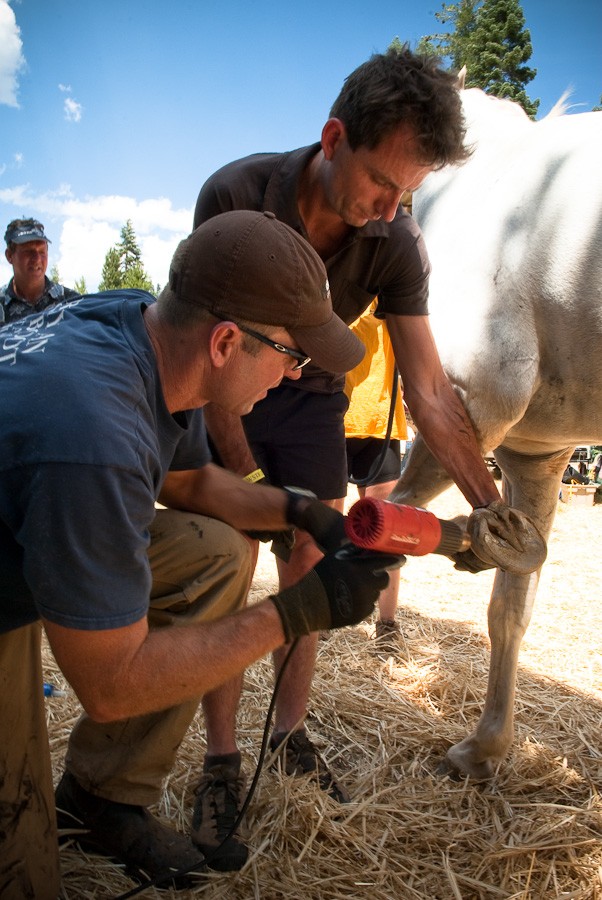
Crossing the 2011 Tevis Winning Hoof Boot With The 2011 Preakness Winning Shoe

Wednesday, February 1, 2012 by Garrett Ford
What do you get when you cross the hoof boot that was used to win the 2011 100 mile Tevis Cup with the polyurethane horse shoe that was used to win the 2011 136th running of the Preakness

A new tool for farriers and hoofcare professionals.  The new glue-on urethane shoe is a collaboration between EasyCare and No-Anvil.  The combined efforts have produced a new urethane hoof protection device that blur the lines between boots and shoes.  The urethane hybrid device absorbs concussion, is held securely in place for a shoeing cycle without nails, is lighter weight than most all nail on shoes and allows the hoof to expand and contract as nature intended. 

Shackleford wins the 2011 Preakness in Burns Polyflex shoes

Shackleford at the 2011 Kentucky Derby in Burns Polyflex Polyurethane Horseshoes
.

Jeremy Reynolds wins the 2011 Tevis Cup in Easyboots

Jeremy Reynolds wins the 2011 Tevis and Haggin Cups in Easyboots.

Below you will find a couple photos showing the collaboration between No-Anvil and EasyCare.  The freshly filed patent includes some of the following features.

1.  Glue-on urethane hoof protection.
2.  The urethane shoe has an internal moldable skeleton for structure and shaping.
3.  The integrally molded cuff increases the gluing surface area.
4.  The urethane shoe and cuff allow the hoof to expand and contract.

EasyShoe.  Half Easyboot, half Burns Polyflex

The EasyShoe.  Half Burns Polyflex and half Easyboot Glue-On.

EasyShoe In Action

Initial EasyShoe prototypes getting some hard core testing.

Stay tuned for more updates and news on the collaboration. 

Garrett Ford

easycare-president-ceo-garrett-ford

President & CEO

I have been President and CEO of EasyCare since 1993. My first area of focus for the company is in product development, and my goal is to design the perfect hoof boot for the barefoot horse.

Thrush: Restoring Hoof Health Naturally by Gail Snyder

Wednesday, February 1, 2012 by Kevin Myers
Gail Snyder recently wrote an interesting two-part article for Natural Horse Magazine on the best practices for managing and preventing thrush.

"Thrush is as controversial a topic as any in the equine world. Everyone has a tried-and-true remedy with free advice for you. If you doubt that statement, type "horse thrush" into an online search engine. In this two part series, I'll cover the topic of thrush in detail."

Natural Horse Magazine Cover

Natural Horse Magazine graciously gave us permission to make the article available to our readers. Simply click on the links below to download a PDF version of the articles. Note: this function requires Adobe Reader to be installed on your computer. If you don't have it yet, you can download Adobe Reader by clicking on http://get.adobe.com/reader/

Here are the downloads to the articles:

Thrush: Restoring Hoof Health Naturally - Part 1
Thrush: Restoring Hoof Health Naturally - Part 2

Let me know what you think of them.

Kevin Myers

easycare-marketing-director-kevin-myers

Director of Marketing

I am responsible for the marketing and branding of the EasyCare product line. I believe there is a great deal to be gained from the strategy of using booted protection for horses, no matter what the job you have for your equine partner.

Minerals Are Good for the Hoof

Saturday, January 28, 2012 by EasyCare Customer Service Team
Various minerals are important for a healthy horse, and healthy hooves. I read a really great article in the Horse's Hoof, Winter 2012-Issue 45, written by Marijke van de Water. Marijke is an Equine Health & Nutrition Specialist, Homeopathic Practitioner and Medical Intuitive. She is also the founder and owner of Riva's Remedies.

Horse hooves are very much a reflection of the whole horse, and the treatment of the hoof should always consider the whole health of the horse. Healthy hoof horn produced by a healthy, well-nourished horse is smooth, strong, and free of horizontal or vertical cracks. Taking care of the whole horse will always benefit the hooves.

hoof

You need to take in to consideration the diet, proper horse hoof trimming and regular exercise to insure good, healthy blood circulation. Blood circulation is how the hoof receives oxygen and nutrients to keep them at their best. We all know that old saying "No Hoof, No Horse".

trim

The Trim

run

Movement

A few of the important minerals talked about in this article, were sulphur, selenium and silica. How they contribute to really healthy hooves. There are organic varieties that are absorbed and utilized much more effectively than the inorganic form. Natural horse products can be easier to assimilate in the body as in nature, horses eat weeds and vegetation out there that is good for them. It just comes natural to them.

Silica promotes bone health, strengthens collagen and hardens the hoof wall, while selenium and sulphur contribute to collagen production and strengthen the cross link bonds in the keratin.

hoof


For a good read and more knowledge, check out this article and then check your horse's hooves. What are you seeing?

Nancy Fredrick

Easycare President-ceo-garrett-ford

EasyCare Office Manager

As the office manager, I make sure the general operations of the organization run smoothly and seamlessly from A to Z. I have been on the EasyCare team since 2001 and have first hand product knowledge as my horses are barefoot and booted.


2011: The Biggest EasyCare Natural Hoof Care Moments & Changes Of The Year

Wednesday, January 4, 2012 by Garrett Ford
2011 is a year that I'll remember for acceptance of natural hoof care practices, hoof boots and barefoot trimming. 

Yes, natural hoof care has been around along time and many people feel it's the only way to keep a horse.  There are also many people who believe all horses must wear iron shoes.  I think the thing that I noticed most about 2011 is a broad, mainstream acceptance of barefoot hoof care.  Horse owners that have had every horse shod for years now have one or two going strong barefoot or booted.  I've noticed a change in thinking, it's no longer a debatable topic but a successful tool in the bag of tricks of the equestrian trade. 

Here is my list of why I believe natural hoof care made a big step forward in 2011, why it will continue in 2012 and where EasyCare needs focus in the future.   I'll start with #1 and cut right to the chase.

1.  Pete and Ivy Ramey release a monumental book about natural hoof care called "Care and Rehabilitation of the Equine Foot".  Pete and an incredible group of contributing authors (Robert Bowker, Hilary Clayton, Brian Hampson, Eleanor Kellon, Kerry Ridgway, Debra Taylor and Kathryn Watts) lay out the importance of hoof care theory, nutrition and the hoof, trimming different parts of the hoof, laminitis management and feral horse foot studies.  The book is incredible and a must read for equine professionals, horse owners and anyone who cares for the equine hoof.  If you believe in the phrase "No Hoof, No Horse" this book will bring your knowledge to a whole new level.

Care and Rehabilitation of the Equine Foot

2.  Tevis Cup 2011.  The toughest 100 mile horse race in the world tests horses, riders and hoof care management techniques more than any other venue in the world.  Jeremy Reynolds wins both the Tevis Cup and Haggin cup using Easyboots on a barefoot horse.  In addition to Reynolds impressive results, Easyboots were used on the 3rd place horse, 5th place horse and an additional 6 horses in the top twenty.  In total 28 barefoot/Easybooted horses finished the 2011 event.  The Tevis Cup continues to show that barefoot/booted horses care compete and win at the highest levels of equine sport.

Reynolds racing wins 2011 Tevis Cup in Easyboots

The Reynolds Racing Team accepting the 2011 Haggin Cup.  Marvel is wearing Easyboots.

3.  Horse Journal names the Easyboot Glove as Horse Journal Editor's Choice and the Easyboot Trail and Horse Journal Best Buy.  Horse Journal is a cool equine magazine that does a great deal of product testing and reviews.  They don't take advertising dollars so their reviews are usually very good and on target. 

Easyboot Glove Testing

The Easyboot Glove on an early testing run.  EasyCare's hopes for this boot have come through. 

4. EasyCare has promoted the $10,000 Hoof Boot Contest since 2005.  Although the Hoof Boot Contest has been very successful and has helped promote hoof boots and barefoot horses in one of the toughest equine sports, 2011 will bring an end to the successful $10,000 Hoof Boot Contest and we will soon launch the inaugural 2012 International Transition Challenge.  The Transition Challenge will showcase horse owner and hoof care professional horse transitions.  The new contest will highlight the importance of routine hoof care maintenance, proper nutrition and exercise.  The change of direction will take our contest focus off long distance racing and put money and energy into a contest where improving the lives of horses will be highlighted and rewarded.  More information will be coming soon.  

Hoof Transition, Before and After.

Before and After transition photos
showcased in That's My Horse #2

5. Advancement, another area of focus for EasyCare in 2012.  It's 2011 and in many areas of the equine industry we are still using products and methods developed hundreds of years ago. Why do other sports like cycling, skiing, climbing, and running continue to advance?  If you look at a bike developed 20 years ago you would think it belonged in a museum.  If you looked at a saddle developed 20 years ago you would think it looks just like the saddles being made today.  One of EasyCare's goals moving forward is to borrow technology from other industries and bring it into the equestrian industry.  Time to look at things differently. 
 

Garrett Ford

easycare-president-ceo-garrett-ford

President & CEO

I have been President and CEO of EasyCare since 1993. My first area of focus for the company is in product development, and my goal is to design the perfect hoof boot for the barefoot horse.


January 2012: Epona's Natural Hoofcare Services

Wednesday, January 4, 2012 by Dealer of the Month
If you've ever met Natalie Herman, you will know her to be dependably positive and honest. Since she started her business in 2005, she believes there has been an explosion of booting options, both in the growth of new boot brands and within EasyCare itself.

Natalie hard at work.

Natalie attributes her success to her burning desire to learn. She finds she can learn something from everyone. Even if she does not agree, there is always something that might cause her to approach a problem from a different angle. She credits her reputuation to the power of word of mouth and her conscientious approach to customer service. "I do some marketing, but it is a fairly tight community around here. If you want to be successful, you need to have people talking about you in a good way."

Natalie says Easycare makes working with their dealer networks and boot users a pleasurable process. "They have a friendly, helpful, knowledgeable staff; they have favorable return policies, and when a product is shown to need improvement, they modify the product instead of sticking with the same old thing."

She uses the same philosophy in her own business: "I am very helpful and giving with my knowledge. If a client has a question, they never hesitate to call or email me with it, and I try and help them. A good trim is just the tip of a large iceberg." She studied horseshoeing first, and credits that time with learning the principles of anatomy and a balanced trim. She feels strongly that evolution is just as important in hoofcare as it is in the boots that protect those hooves.

Natalie is quick to compliment EasyCare: "I love how inovative Easycare is, always trying to come up with new solutions to existing boots, or totally new boots when the need arises. Instead of insisting that the user is at fault, or the trims are incorrect, EasyCare tries to find a solution to boot failures by either modifying the boot design, or coming up with a design that fits the activity of that user. She says she's still waiting to see a sliding plate boot, though. "It just amazes me how fast things are changing in the industry," says Natalie, "and I am loving it."
 
Natalie currently owns three horses: a 13 year-old Morgan/Quarter Horse mare that was her first horse and, she says, her best horse. "I tried about everything with her, and she is currently being leased to a friend's daughter. Together they won the state championship for CSHA Trail Trials in their division this year, bare and sometimes booted with Gloves. She was also her experimental horse for getting into barefooting. She always needed shoes with pads in the front, having long toe/low heel issues, and wore the outside branches of her hind shoes to nothing in six weeks. Natalie was skeptical of taking her barefoot. "Her feet became so much better that I decided to completely convert my farrier business to natural hoofcare." She has never looked back.

Natalie & Storm.

Natalie and Storm.

She bred the mare to the top AERC mileage and Hall of Fame stallion, DR Thunder Bask, and this year her six year-old daughter completed her first endurance season. She has been bare her entire life, and performed wonderfully in Gloves, Epics, and Glue-ons at rides throughout 2011. "She is also my 'thinking outside the box' booting horse. I have had to modify boots and how to apply them to the hoof with her, as she tends to have a lot of torque on the hind end." Having a challenging horse in booting has helped her help others.

Natalie also has a 13 year-old Kentucky Mountain stallion. "He is my 'soul horse' and I love everything about him."

Natalie and E.

Natalie & Eowyn.

As a small business owner, Natalie keeps a minimum stock for clients, and appreciates the fact that Easycare does not have a minimum order policy amount. Her best-seller is still the Easyboot Glove and Glove Wides. "Most of my cients love them as they are so simple to use. The next best-selling models are the Epic and Easyboot Trail, as both allow a greater range of fitting for clients unable or unwilling to keep the hooves trimmed as frequently as the Gloves require.

Her most rewarding experience as a trimmer was treating her first founder case. "I knew the theory, and had trimmed a few mildly laminitic horses, but not a really bad case. When I called the vet for a consult and to go in and see the radiographs, the vet had basically written the horse off and told me to expect to see the coffin bone coming through the sole." She never did get sole penetration on that horse, but there were months of abscessing. Today the horse has textbook hooves. "This case got me started on the path to working on laminitic horses and it boosted my confidence in the barefoot method."

Natalie's most memorable hoof boot success story is the 2011 XP 2,000 mile ride. "There were a good number of barefoot and booted riders already, but there were also many shod horses competing." The barefoot horses proved to be most of the highest mileage horses on this ride, with over 1,000 miles each during the two-month span. Riders with shod horses discovered the benefits of barefoot/booted protocols, and many of them solved lameness issues during the race by pulling shoes and applying boots. "So much for an extended transition from shoes," said Natalie ironically.

Natalie's Calling Card

Natalie's calling card.

Natalie's prediction for the future? That a barefoot and booted lifestyle will become the norm instead of a fad. "More and more vets and long-time farriers are becoming interested in it. As boots become easy to use and effective as hoof protection, more people see barefoot and booting as a viable option for their horse's hoofcare.

For more information on Epona's Natural Hoofcare Services, visit Natalie's new Facebook page. For more information on becoming a dealer, visit the Dealer's Corner on the EasyCare website.

Natural Hoof Care in Europe

Monday, December 5, 2011 by Christoph Schork
Dresden, a pearl a the river Elbe in Germany, was the first stop of a 4 week Hoof Care Tour last month conducted by me, The Bootmeister from Global Endurance Training Center.

I have been going to Europe now for the last two years, sharing some gained hoof care and hoof protection Knowledge with riders, horse owners and farriers. The demand for more knowledge is high, people are eager to learn about Natural Hoof Care and the newest  Hoof Protection products on the market. EasyCare is the undisputed leader in the world with research and development of hoof boots of all kinds. R&D is of utmost importance to the EasyCare staff. Horse owners worldwide know that. Hence, it is only logical, that EasyCare boots stood in the lime light of my presentations.

Dresden

View from the Frauenkirche over the Castle and the Elbe.

After an indoor anatomy session and PowerPoint presentation, the 20 participants had ample opportunity to train their eyes during conformation analysis sessions and study first hand how conformation affects hoof growth. Afterward, the riders who brought their own horses, in total over 10, could practice mapping out the sole and rasping the hooves of their horses. I placed a lot of emphasis on developing the skill of reading the sole. Aspiring hoof trimmers generally fare well when following the principle of trimming a hoof no further than to the live sole. It is a safe approach and everybody can learn it quickly.

The second day was devoted to Hoof boot selection and application. I explained and demonstrated the usage of Easyboot Edge, Trail, Glove and Glue-On and afterwards everybody could practice. It is important to actually do things. We humans all learn most by doing, we easily forget when just watching and listening.

Gluing

Demonstrating the use of Vettec Glue gun and application of Adhere to the Glue on shells.

Glue on

Finished gluing job.


Coaches in downtown

These coaches in downtown Dresden provide visitors a feeling of stepping back in time. After looking at the hoof protection of these carriage horses, we all agreed that they would travel  much more comfortably with Easyboots.

Coaches

Next stop was Hannover. Well known for the Hanoverian breed, this city has a long horse tradition.

The on-site organizing committee had invited over 45 Hoof Trimmers, farriers and veterinarians. After my initial presentation about the different Natural Hoof Care schools and philosophies in the USA and Europe, we discussed NHC and trimming techniques as well as hoof pathologies and remedies. I presented the thesis and studies of Dr. Brian Hampson of Australia, who did the most thorough studies on the hooves of wild horses so far.

If someone were to conduct a study, for example, on the hooves of one herd of wild horses  in Nevada or Utah, the two driest states within the USA, where horses have to travel many miles over rocks and sand to find water and food and then propose to use that feral hoof as a benchmark model for healthy hooves for all domestic horses in the world, would that be a realistic and fair conclusion?

Hampson studied and examined hooves from various areas in Australia,  wild horses living in arid areas and others in wet areas with lush vegetation. The hooves of the wild horses living in the wetter areas looked a lot like the average domestic hooves. Does that mean the hooves adapt to the environment or are the hooves shaped by the substrate the horse travels over?

An answer to this question might be obtained by looking at the following photos, provided by Brian Hampson.

Hampson

explanation

The left hoof has the appearance of a typical domestic hoof. Recessed frog, under-run heels, flares. Yet, it is a wild horse hoof. After moving several horses with these hooves to a different (drier) area, the hooves were remodeled by the ground the horses traveled over. The hoof on the left is void of any mustang roll. Does it not need it? Within 16 weeks the rocks and dry ground reshaped that very same hoof. The mustang roll is clearly visible now. The question might be asked, how important is the mustang roll then, when we as natural hoof care trimmers applying it to all horses, yet only a small segment of wild horses worldwide even display one in the wild?

The study also showed that only three hooves out of 100 assessed were free of abnormalities. In fact, he found a 67% incidence of chronic laminitis within the horses living in the dry climate and the hard substrate. When the majority of the wild horses display this pathology, is it still a pathology or is it physiologically normal now? Who makes these decisions?

Not everything wild is necessarily good solely because it is wild and natural. The wild horse paradigm model of desert horses' hooves may not be applicable across the board to all horses worldwide.

The discussions were very interesting and we were only scratching the surface of all the ramifications of the Hampson study.

Hannover

Discussions of Natural Hoof Care in Hannover.

On I went to Kassel, stop for the next seminar. 

Similar to the USA, Germany experiences also a shortage of farriers who are willing to offer services beyond the traditional iron shoes. Many do not know about bare hoof trimming and alternate hoof protection like plastic shoes and hoof boots. Therefore, more and more riders and horse owners want to learn to trim their horses' hooves themselves.

I set up several stations, where people could work on their horses hooves simultaneously. That way, everybody had ample time to practice and learn.

kassel

Working at stations.

Onwards to Belgium. near Brussels, I conducted the last clinic. My French is very rusty, to say the least, so everything was translated by Leonard Liesens, a famous and successful Belgian endurance rider.
I learned to speak slowly and to include only essential information in my sentences. And I got my message across as well, without lengthy and repetitive wording. An exercise in disciplining speech.

brussel

The historic Market Place in Brussels.

leonard

Leonard Liesens checking the fit of the Easyboot Glove he had just applied.

At all the seminars, I also showed slides of the Tevis ride. With all the Europeans now coming to the Tevis next year, we better all put our entries in early to avoid being placed on the waiting list.

The Europeans were all very eager to learn and try new trimming techniques. They are pragmatic and want to use the trimming and hoof protection that works best for their horses. They do not believe that Natural Hoof Care and Bare Hoof Trimming is an ideology or a mantra. For them, it is not an absolute, rather a better and healthier way to take care of their horses' hooves. They do not want to listen to self righteous statements of cult-like organizations. The welfare of their horses is important. That is a reason why Pete Ramey stands in such high esteem in Europe, his open mindedness, his tolerance, his knowledge and non judgmental approach to hoof care puts him in a class of his own and a big step above everybody else.

I did stress the importance of looking at each horse as an individual. The trimming procedure that works for one horse, might not be the best approach for the horse right next to it.

Europe has many more horses than the USA. Per capita, Germany has 70% more horses than the USA. Horse owners and riders want to learn and improve and use modern and better hoof protection methods.
Already now, I have booked several more clinics for next spring, this time in addition to Germany also in France and Switzerland. Natural Hoof Care, Barefoot Trimming and Easyboots are on a roll and gaining ground and popularity throughout the whole equestrian world.

August

Golden statue of August Der Starke (August The Strong), former King of Saxonia, in Dresden.

A special Thank You goes out to my liasons and support persons who organized the events on site. Without them, it would have been very difficult to impossible to conduct the seminars:

Dresden:     Veit Koppe

Hannover:   Patricia Nastoll and Kathrin Ewen

Kassel:        Martin Boesel

Brussel:       Leonard Liesens


The Bootmeister, reporting from Europe


Shawnee Forest Trail Ride

Saturday, October 8, 2011 by Hoof Boot Stories
My friends recently enjoyed trail riding at the Shawnee National Forest in Southern Illinois. We all practice the barefoot natural trim and used Easyboots on the ride. The boots were a huge success. All our horses performed well through the mud, creeks, and rocky terrain in their boots. Thank you EasyCare for many great products.

Easyboot Gloves

Name: Cindy B.
City: Danvers, Illinois, USA
Equine Discipline: Trail
Favorite Boot: Easyboot Glove


If I Only Had Four Frogs

Tuesday, October 4, 2011 by Dawn Willoughby
"If I only had four frogs." Is this your horse's lament?

Pathological frogs are so common, that they have become the norm! Just as long toes and under run heels are normal for thoroughbreds, sick frogs are nearing normal for most horses. What else do we see in my home state of Delaware where we had an amazing 26" of rain in August, normally one of two driest months!

If you have not been following my posts in Notes From the Field, I hope you will check them out. The importance of the frog for excellent, barefoot movement is discussed in detail. When you know what a healthy frog looks like, how bad ones heal, along with the various soaks, topical treatments, and tips for, in Pete Ramey's words, out running thrush, you will have the tools to maintain frog health.

It can be a job, there's no question about that. Gird your loins and let's get to it!

Four Butt Cracks, Four Sore Frogs

Four butt cracks means four diseased frogs.

For starters, my most common errors in earlier days were:
(A) Not cleaning the area before treatment. (Thank you Linda Cowles!)  
(B) Not taking frog health seriously until the horse was ouchy. Then inconsistent treatment.
(C) Stopping treatment too early, only to see the same sick frog in a month.
(D) And ever using Thrush Buster. It contains formaldehyde which kills healthy as well as diseased tissue, according to my chemist friend. Get rid of Thrush Buster!

Just Frogs
  1. Healthy, functional frogs
  2. Diseased and unhealthy frogs
  3. Recovering frogs
  4. Pick and **clean**
  5. Treatment Recipes (Thank you Laura Florence, barefoot trimmer and body worker)
  6. Soaking Recipes (ditto)
  7. Thoughts on Out Running Thrush

1. Some Healthy Frogs

Cadence, a Quarter Horse

Meet Cadence, a quarter horse, on his first trim. Over time his foot became more oval but for this trim, I assumed the frog was where it needed to be, for ideal function. No need to 'pretty' things up. The back of the frog is broad and became even broader over time. What a landing pad! The frog's perfect center, the central sulcus, is a shallow thumbprint. Perfect! The lateral grooves on either side of the frog are about 3/4" at their deepest and they are dry.

Mason

I guess Mason, who hides his appaloosa spots, wins the prize on this one. BTW his trimmer is his owner, Carlyn. Massive, robust frog allows Mason to land solidly on the back of his foot. Again this was early in his career from bare to better.

Kay, a large pony

Large pony, Kay, had been barefoot a long time with a pasture trim. Over time, as she grew out her flared wall, her toe shortened significantly. (Knowing more now, I would have brought it back.) Although not as pretty as the preceding frogs, the rear of the frog is wide, the center is free of disease. Looks like some older frog tissue is shedding and new coming in. I didn't 'beautify' it with my knife as there were no nooks or crannies for disease to settle into.

2. Unhealthy Frogs
The most common problem I saw during my years as a professional trimmer, was diseased central sulcus of the frog. It may or may not be sensitive. Doesn't matter. Butt Cracks are not healthy and should be treated rigorously. Technically many frogs don't have thrush; but they have something! Whether it's bacterial or fungal: pick/brush, clean and treat, soak, then outrun it.

The worst frog I ever saw was a puddle of black gooey thrush. The horse was stalled in a Philadelphia 'city barn'  22 hours a day and the stall was cleaned once a day. Standing purposely in urine relieved his itchy discomfort.  The poor horse would never recover in my view. I suggested the owner relocate her horse to the country and field board him near her home. I gave her a plan for daily treatment. I did make the mistake of investigating the frog with my knife and it began to bleed immediately.

Banjo, OTTB

From the back you can clearly see Banjo's (OTTB, my very first trimming guinea pig) 'butt crack' between the heels bulbs. Remember to check the solar (bottom) view of the frog, either side of the frog and the bulbs as viewed here.


Banjo, OTTB

From the bottom or solar view, we see Banjo's pencil thin, deformed frog. It does look like the central sulcus is filling in with healthy tissue. Frog healing and the opening or decontraction of the heels takes time and patience. Banjo was pasture sound throughout. If I could go back in time, I would have put him in padded Epics with lots of Gold Bond Powder and hit the trails. Sound stimulation helps 'outrun disease'.  I only had a long weekend of training under my apron and the occasional help from the barn's farrier when I first laid rasp on wall. Even so, Big Band Show was better off out of metal shoes. The improvement in his health was dramatic and almost instantaneous!
You go Owner-Trimmers.

(Above) The Healing Frog and Contracted Heels: Banjo's photo above gives a nice view of heels that are very close together, contracted. They do this to protect the weak frog and above it, the digital cushion. With treatment and lots of sound, heel-first landings a foot like this recovers, every time. The heels start to decontract when the foot is ready. And internally the digital cushion and lateral cartilages come back to life.

Cayuga, unraced 15 year old TB

Contracted Heels in Shoes:
Just by watching horses pass by, you can tell when shod horses have a weak back of foot. The heels look pinched. The back of the shoe is almost touching. Above the hairline, that bulge pressing up the back of the foot, is the lateral cartilage. It's 100% non-functional. This is Cayuga, an unraced thoroughbred at 13, shod most of his life. Sadly I could go in almost any barn where horses are shod and find a variation on this theme.
Cayuga, unraced 15 year old TB

I gingerly removed the shoe, nail by nail. Can you see how pinched the back of the frog is. The heels too are very close together, protecting the back of the foot. It can get worse; the heels can actually touch. This thoroughbred was not lame in or out of shoes. It took a long time to rehab his feet to health and repair his body. Soundness is a 'whole horse' issue. I fitted him in Epics with black sole pads and black frog pressure pads, to provide stimulation when ridden. He was ridden right out the barn.

The last time his owner tried barefoot, the horse was lame for 7 months before she gave up. The horse was lamed by aggressive trimming. Great hooves are grown. No need to match someones concept of 'ideal'.

For a horse like this, and sadly my own boy at the moment, the owner must make frog care an essential part of daily rooming. If you must, skip something, do not let it be hoof care. After all, no one died from a crappy looking tail!

3. Close to Recovery
Frogs heal from the inside out.

The central sulcus of the frog heals from the inside out.

Now time to roll up your sleeves: I pick and brush each foot, using the combo hoof pick, then clean the foot, treat and boot for riding.  Then and only then, I tackle any remaining grooming before heading out. This way the frog is assured of an hour or more of treatment. Even if I don't ride, I treat the frogs daily, in the field if I am pressed. If you can't visit your horse every day, perhaps you can hire someone at the barn to do it. Or do some swapping. Every other day should do the trick too.
Feet Treatment Bucket

Sunny's FEET Treatment bucket with all his daily needs: "Goop", Tea Tree Oil, Manuka Honey, Cotton Balls, Spray Bottle of Dilute Anti-bacterial Soap, Hand Towel and Hoof Pick.

I found that rigorous treatment was much less of a hassle when I finally broke down and got everything I needed and put it in one place, Sunny's Feet bucket. Note: Check with your vet on specifics on any of the recommended treatments or other ones you might find at the tack shop or on-line. The 'natural' claim doesn't always mean good.

First do no harm. If your horse flinches during care, find another pain-free way to work. Twice now, I have been hired to trim horses who kicked farriers because of previous rough and painful treatment by hoof pro, owner or vets. It took me one or just a few visits to gain the horses' trust using clicker training. Why traumatize the horses we love?

4. The Basics for Daily Cleaning 
  • Hoof pick with brush. Hand towels.
  • Scrub brush, bucket and anti bacterial soap like Dawn dish detergent diluted or,
  • Fill a spray bottle with same or,
  • Fill a wormer tube or syringe with same.
  • All antiseptic liquids are diluted: Dawn, Lysol, etc.
I wouldn't treat my own deep cut without washing it first. Well same goes for my horse. Obviously scrubbing four feet (why not do all four since you are down there?) is much easier if you have a wash stall. Since I don't, I first tried filling up wormer tubes or syringes and irrigating the frog crevices with anti-bacterial soap, Dawn of course. But refilling was a hassle. I switched to a spray bottle and a small towel to 'floss' the area clean. I mixed a milk jug of cleaner for quick refills.

If the central sulcus were more like a deep crevice, I would certainly use the thin tipped syringes in addition to irrigate the wound. Q tips are handy too.


Medium pony, lame in shoes due to sore frogs

Medium pony lame in shoes. The central sulcus was 1.5" deep. First steps were to get her out of shoes, out of the stall and into a daily treatment regimen.

Central Sulcas was 1.5" deep.

Her young owner could ride the pony in Epics with green pads.

One month later.

One month later, the heels are decontracting a bit. The central sulcus isn't as deep.  Full healing just takes time and diligent treatment.

5. The Basics for Treatment  Pick a couple of alternatives. I rotate 3 to avoid tolerance.
  • Make your own Pete's Goop: 50% antibiotic cream and 50% anti fungal cream in syringe.
  • Purchase cow mastitis treatment like ToDay  (12 syringes in a box), available on-line or at Tractor Supply. Recycle the syringes for Goop above or irrigation tool.
  • Tea Tree Oil from the health food store. Mine comes in a handy spray (onto cotton) bottle.
  • Mashed Garlic is anti-bacterial and comes in a jar. Check your grocery store.
  • Calendula Cream (Thanks again to Laura Florence, barefoot trimmer) from the health store.
  • Raw Honey wax free. No Smirks! Honestly! It's used on, among other things, human burn victims.
  • Or even better but more expensive (unless you're a kiwi), Manuka Honey from New Zealand. It has many uses, including repairing wrinkles! (I'll get back to you on that).
  • Cotton balls from the pharmacy. Q-tips are nice but not essential.
For Pete's goop and the others above, I have found 2 methods of application.
(A) The more time consuming one is to mix the 2 creams well. Then stuff into a fat wormer tube and then inject into an Exel 12 cc curved tip syringe. Perfect for deep crevices. Pull apart one cotton ball so there are no painful lumps and gently pack, using hoof pick, into the central sulcus.
(B) When the crevice isn't that deep, I dip the half cotton ball into the Goop or Honey and stuff it into the frog with a hoof pick. This eliminates the syringe filling step which is harder than you would think.

When I can no longer stuff a cotton ball in the sulcus, I spray Tea Tree Oil until 100% healthy.

Soaking for deep penetration of gases with White Lightening.

Bagged and booted for a soak in White Lightening.

6. The Basics for Soaking and Irrigating (Thanks to Laura Florence my favorite barefoot trimmer)
If frogs are particularly bad or you simply have the time, soaking the feet is a great idea to create an environment hostile to bad bugs. I soak once a week when treating frogs. I set Sunny up in his otherwise unused stall with some extra good hay and a fan. I hang out on a straw bale with a horse book. OK, honestly he makes me dip his hay in water and hand feed him. When he's full, we take our naps.

Soaks, alternate or use your favorite:
  • Easy Care Soaking Boots
  • White Lightening and White Vinegar. I use 1/8th cup of each.
  • If using above, sturdy waste bags and duct tape to fully enclose foot and capture gases.
  • Or 50% Apple Cider Vinegar with 50% water
  • Or 10% Bleach and 90% water
  • Or 1-2 Tablespoons/boot of Lysol with water
  • Or some Borax dissolved in water
According to the techs at Grand Circuit Products, makers of White Lightening, you can soak as often as every other day with White Lightening. The dilution is active for 8 hours. If you are short on funds but long on time, you may rotate one boot, 30 minutes a foot, to all feet. The foot must be bagged to capture the gases that provide a deep penetrating soak. I will use it on an abscess, cracks, etc. It's available online or at the farrier supply store. They recommend 1/4 cup but I think that's excessive since it's the gases that do the trick. Gases are released when you combine White Lightening and Vinegar. You can add the same amount of water to increase volume.

The rest of the soaks require soaking boots or buckets if your horse is quiet.

I generally irrigate the frog with the soaking material in a syringe after removing the boot.

Additionally:
  • Q tips for cleaning frog crevice.
  • Gold Bond Powder for riding boots keep the foot dry in many conditions and again, create an environment hostel to bugs.
  • I generally do not recommend the RX boot or Equicast because I don't want to enclose the foot.
  • Thrush Buster has formaldehyde. It kills healthy and unhealthy tissue!
  • Dr. Bowker once recommended leaving dirt in the collateral grooves on either side of the frog as it may have a role in hoof mechanics. But for my environment, it's just not practical or healthy.
  • The Horse's Hoof has an excellent series on hoof treatment.
Whether in field turnout, in-hand, being ponied or mounted, sound movement heals.

In Hand at Walk

Jill Wilcox (80 yrs) work 'in-hand' with Runner (OTTB) at the walk. Working along the wall with a pole encourages, first straightness and then balance. She will progress to trot and canter in-hand. All her students work in-hand before mounting. (Note she uses reins attached to nose band, no bit and a neck band.)
It's much easier for the horse to move correctly without the rider.
7. Out Running Thrush or Bacterial Infections
The first time I heard the phrase, out running thrush, at a clinic, I hadn't a clue to the meaning. I have learned the hard way that we have to grow healthy tissue faster than the bad bugs inflict damage. Simply treating a stalled horse, for instance, might not be adequate. One of our Barefoot Mantras: Sound Movement Heals.

If your horse is sound in padded boots, ride him, even if it's just at walk. If not, consider 'ponying' him, again in padded boots, off another horse. Turn him out with a busy herd or a nasty pony. No standing around in sheds with manure floors. No shoes. No stalling. If you are boarding in a mud hole, leave.

Pea Gravel feels good to even the sorest horse, human or dog.

Pea Gravel feels good, even to the sorest horse. It offers just the perfect amount of stimulation.

I have seen some farms where you just can't avoid a rocky path to the pasture. Consider covering it with cut up stall mats for your sore pony. Better yet, dig it up, add some landscaping material and fill with 4" of pea gravel. Add pea gravel to the loafing areas. It's a miracle cure that Dr. Robert Bowker has discussed in a published work. Make a copy for the owner if you board.

As for the trim, leave a little heel so the frog can get just the right stimulation to grow, but adequate protection. Once you've got a nice frog, those heels will come right down, where they want to be.

I'll trim the frog to remove flaps and hide-y-holes for disease. Beyond that, all I can say is think before you cut or snip. Removing diseased frog can be tricky. If you trim a sick frog and it bleeds, your horse is now open to infection. Cutting open the central sulcus to let the air in often lames the horse which in my view is abusive. I move cautiously and respectfully.

As you can see, I have become a passionate student of the frog! Most of the lessons were learned the hard way. I hope this helped you. Feel free to share and post at your barn.

Happy Trails,
Dawn

P.S. Find more good reading and free trimming videos go to my site 4sweetfeet.com
P.P.S. For my next post look for Clicker Training Your Horse During the Inevitable Down Time, December.


Phoenix Loves His EasyCare Boots

Wednesday, September 28, 2011 by EasyCare Customer Service Team
I met Phoenix exactly 4 years ago when he was a newly gelded 3-year-old and I was nearly 50.  He was looking for a home at a bargain price.  You see he was a Thoroughbred, bred to race, who as fortune would have it "didn't like to run fast."  I fell in love with him at first sight even though he was underweight and a lot of horse to handle.  I told myself his problems could be solved with some good groceries and kindness and wrote the check with enthusiasm.  So that I wouldn't have to worry about his feet while we were adjusting to each other, I had metal shoes put on immediately.  That was the first and only time.  I began to notice that his natural gait was very low to the ground and that he dragged his back toes with almost every stride leaving him with an unnaturally square toe.  I investigated possible nutritional, behavioral, structural and developmental causes for his gait.  I concluded to the best of my ability that was his way of going and so long as he remained sound I'd do my best to work with it and continue his training.  We immediately began a diet to support good hoof growth and when the shoes came off I didn't replace them.  I wanted to have complete control over his feet so I could keep them balanced and short and started trimming them myself every couple of weeks. 

Phoenix and boots

Phoenix in his EasyCare boots.

I realized I would need the help of protective gear for his feet since I planned an athletic future for Phoenix.  I had seen EasyBoots on the market for many years and realized it was time to give them a try.  I loved having various designs to choose from.  We started out with Epics all around.  His front feet were easy to fit snuggly, but not so much in the rear.  He'd wear the buckles off of the epics by dragging his feet, still his precious toes were nicely protected.  Eventually we settled on Bares.  They go on nice and tight and have a 'toe shield' on the front as if they were designed specially for my horse.  Because Phoenix was so tough on his boots I had to learn to make repairs.  Since my local dealer was less than supportive, I went directly to customer service at EasyCare, Inc. with wonderful results.  I learned it wasn't too hard to work on the boots and rather than tossing old boots I cultivated an extensive bone yard for scavanging parts. 

boots

Easyboot  Epics on front and Esyboot Bare boots on hinds.

Phoenix continued to get plenty of exercise and good nutrition and the quality of his hooves was better than I expected.  Imagine that, a Thoroughbred with good feet?!  Two years ago we started experimenting with limited distance endurance racing.  He finished the races sound.  I was thrilled.  During one race we rode through a severe thunder and lightening storm with multiple stream crossings and flooded trails.  I lost a boot.  At the vet check the farrier was about to put on a metal shoe so we could finish the race.  He commented that it was a shame to nail a shoe onto such a healthy hoof.  At that moment, as if by magic, the missing boot was found and returned to me by one of the riders.  We were able to reboot and continue the race.

Thanks to EasyCare, Inc. for a great product and superb customer service!
 
Brenda and Phoenix

Do you have an ex-race horse that you are rehabilitating? Are you going barefoot?

Nancy Fredrick

Easycare President-ceo-garrett-ford

EasyCare Office Manager

As the office manager, I make sure the general operations of the organization run smoothly and seamlessly from A to Z. I have been on the EasyCare team since 2001 and have first hand product knowledge as my horses are barefoot and booted.

First Project: Lil' Rick's Gal

Thursday, September 15, 2011 by Kate Saunders
With the success of the pony horse, 91, and visual signs of improvement in several horses who were brought to their farm for me to work on, Lisa nonchalantly suggested that she would like me to meet her at the training center ("the track") to look at a few horses currently racing. I like to believe that she just got tired of trailering horse after horse from the track to the farm. Whatever the reason, Yippee! 

Track Barn
Victor and Lisa's Barn at the Training Center

You'd think this would be an easy thing to do. Just show up at the training center, drive to the designated barn, and that's it. Oh, no. Not the case at all. Just as Garrett Ford suggested in his blog, blog.easycareinc.com/blog/hoof-boot-news/the-horse-that-wasnt-allowed-to-race, the racing industry is FULL of red tape. After about a week of running around from place to place, I finally acquired my "Plater's" license (not an easy feat since I had no proof that I had any ability or intention to put racing plates on horse's feet), and was allowed to enter the training center property.

Mug Shot
A mug shot would have turned out better than this

As if rewarded for a job well done, I was presented upon my arrival to the training center with my first project: Lil' Rick's Gal.

Lil' Rick's Gal

Ricky is a 5-year old mare who arrived at the training center with sore feet. For months, Lisa and Victor worked with the track farriers to find something that made Ricky more comfortable. Metal shoes did not help.  Lisa and Victor knew that something different had to be done; this horse could barely walk, let alone hold a rider on her back.

Poor Rick

During the time that Lisa and Victor were struggling with Lil' Rick at the track, I had one rehab race horse out of his boots and on the road to recovery at the farm. Lisa, feeling more confident in the natural hoof care technique, decided to do something that most likely had never been done in the entire state of Louisiana: She brought those boots to the track! For 60 days, 20 hours out of the day, Lil' Rick stayed in her hoof boots. She was hand walked each day, several times a day, for gentle exercise until she was comfortable enough to go on the walker.

Rick in Epics

By the time I was finally brought into the excitement, Lil' Rick was not only walking on the walker, but had actually begun exercising on the track with her size 0 EasyBoot Epics!

And so the EasyBoot Epic made its way into Lisa's heart and onto a Louisiana training track.

At first, the exercise riders were skeptical of these contraptions on her feet, and agreed only to pony Lil' Rick in her boots. That is to say, the riders were afraid that the boots would come off at high speeds, and so they agreed at first only to ride a pony horse while leading Lil' Rick on her exercise routine. They did not want to be on her back when those boots came off.

Rick on Track with Epics

And it is true, the boot did require some tweaking. With a little sports tape, the boots now stay on throughout her morning exercise routine. The downward buckles do pop up and so we may swap out the current buckles with up-buckles, instead.

Sports Tape
Sports Tape Post Morning Work Out

Today, Lil' Rick can not only trot down the aisle barefoot, but she is currently running BAREFOOT (not even boots) with a rider on her morning exercise routines!

With the background on Lil' Rick set, we now come to the speed bump in the road that defines the racing industry. Ricky has run and WON one race since she began her rehab with the EasyBoot Epics. However, just before the race, the track farriers glued aluminum shoes on her fronts, and nailed aluminum racing plates on her back feet. Lisa did make sure that those farriers took nothing off of her feet when applying the shoes. At the time of that race, Lisa did not know of any better options.

Lisa and Victor are still concerned about traction and the need for something on a race horse's foot as she leans into the curves and navigates around other horses. However, with Garret Ford's Race boots that he has been working on, the Arceneaux barn (and their kooky natural hoof care trimmer) have hope that we may have a number of great options coming our way.

In future posts, I will provide the nitty-gritty on attempting to fit EasyBoot Gloves and Glue-Ons onto Lil' Rick's tiny feet, provide feedback on exercising in these two products, and hopefully, make some headway with the racing secretary in approving an EasyBoot Race for official races!

Saddle Care Tips And Cleaning Advice

Saturday, September 10, 2011 by EasyCare Customer Service Team

After your horse, your saddle is likely the most expensive part of your equine gear. For this reason alone, it pays to take care of it and do everything you can to preserve it.
 

saddle
Even one named for the Duke

With a few exceptions, saddles are generally made of leather. You can care for and preserve your leather saddle just as you take care of and preserve your own skin.

Most saddles come from the factory or saddle maker's shop with the leather properly conditioned and ready to ride. Saddle makers usually include information on how to care for their saddles and it's best to follow their instructions. If you've lost the care and cleaning information, or you bought your saddle used, chances are the manufacturer has a website where you can find either instructions or a phone number to call for information.

              saddle 2                      bick 4      

Most saddles are made from hand selected saddle skirting leather, chosen for its durability and extreme strength. However, any leather must receive regular care to preserve this strength and long life. At least four times each year your saddle should be completely cleaned with a good soap or detergent, then oiled thoroughly with a good neatsfoot oil. In wetter climates this should be followed more often, as continued moisture is very harmful to leather. With a program of reasonable care, your saddle should last for many years.

Here are the 7 SECRETS of Saddle Care offered by Circle Y Saddle Makers......
  • Do not store saddle in plastic or other non-porous covers.
  • Allow a wet or damp saddle to air-dry naturally away from any other source of heat. Apply a little Bick 4 leather conditioner when the saddle is nearly dry to restore flexibility. Condition thoroughly with Bick 4 when the saddle is completely dried.
  • To prevent mildew, protect the saddle from excessive humidity. In a dry environment, regularly condition the leather to prevent the saddle from drying out and cracking.
  • Do not use waxes, silicone or other leather preparations that impair the ability of the leather to "breathe".
  • Dubbins and greases are bad as they seal the pores and are greasy, thus picking up additional dirt and dust and slowing drying time.
  • Never use caustic household chemicals to clean leather. Avoid preparations that contain alcohol, turpentine, or mineral spirits. We recommend Bick 1 as it is pH balanced to be compatible with leather.
  • Do not use mink oil or other animal fats. They will darken leather. Animal fat can also turn rancid, causing the stitching and leather to rot.
Do you have secrets or products used for caring for your saddles? Tell us about that and share your hoof care tips on our Easyboot Facebook page.

Nancy Fredrick

easycare-office-manager-nancy-fredrick

EasyCare Office Manager

As the office manager, I make sure the general operations of the organization run smoothly and seamlessly from A to Z. I have been on the EasyCare team since 2001 and have first hand product knowledge as my horses are barefoot and booted.

Why Is The Horse Industry One Of the Slowest To Change?

Thursday, September 1, 2011 by Garrett Ford
Look at the other sporting goods industries and see how fast they are changing. Mountain bikes change every year and we are now seeing carbon frames, carbon wheels and complete bikes that weigh less than 20 lbs.

Specialized Carbon Epic
The 2011Specialized Carbon Epic. Carbon frame, carbon wheels and now 29 inch wheels. All not available four years back. The $9,900.00 price tag is a result.

1982 Specialized Stumpjumper

1982 Specialized Stumpjumper. Even the non bike people can easily see an industry that thrives on change.

Look at downhill skiing and the technology in shaped skis, boots and bindings. They get better and better every year. Look at something very gear free like swimming and the advancements in low drag swim suits changes yearly. Look at golf. Golf club technology is new and improved every year. You blink in these industries and you get left behind. Compare these industries to the equine industry and the fact that the majority of our equine partners are still competing in iron shoes and saddles that haven't changed in decades.

The slow rate of change and acceptance in the horse industry has been personally highlighted by a recent entry into the flat track racing industry. I've written about our journey trying to enter the world of flat track racing and it's a perfect example of why the horse industry is slow to change. Take a peek at the story here "The Horse That Wasn't Allowed to Race"

Clunk Racing at Arapahoe

Clunk racing at Araphoe Park in aluminum plates. Clunk was scratched twice because he was not allowed to race in a glue-on urethane shoe.

Most other industries are changing at a rapid pace, so why is the equine industry so slow to change? Look at the racing industry as just one example. Life on the race track presents challenges to the equine hoof. Many track horses have challenges with brittle walls, tender feet, lack of support, and contracted heels from continuous shoeing. Track horses that rip off a shoe and lose hoof wall also have a difficult time holding shoes and as a result miss conditioning and races. Track horses are subjected to pounding workouts and as a result are prone to injury. Is the aluminum race plate the end solution? Is an aluminum racing plate the end game? We don't believe it is and for the reasons above EasyCare believes the sport could benefit from a more supportive shoe.

The technology is available to make a lightweight race shoe for the equine track athlete. EasyCare has developed a shoe that offers the following.
  1. The Easyboot Race will allow the hoof to expand and contract as nature intended.
  2. The Easyboot Race will provide support and comfort for quarter cracks.
  3. The Easyboot Race will allow farriers and trainers another tool for problem feet that will not hold nails.
  4. The Easyboot Race will allow farriers and trainers an option that flexes and absorbs concussion to extend the horse's health and longevity.
  5. The Easyboot Race can be trimmed and modified to suit a specific horse, track or surface.
  6. The Easyboot Race will be less likely to hurt horses, jockeys or spectators if they do come off.
  7. The Easyboot Race will allow trainers to train the horses harder and on less than perfect surface conditions.
  8. The Easyboot Race will bring the track an affordable glue-on solution.

Alunimum plate

Aluminum Racing plate used today.

Aluminum Plate

An aluminum racing plate used in the 1980s. Yes it's the same shoe. Nothing has changed.

The track seems very hesitant to change. Although we have tried everything to learn the rules and participate at Arapahoe Park with new hoof protection that gives the industry options, we have so far not been able to compete because the stewards and race director have determined the Easyboot Race shoe violates rule 7.608.

Easyboot Race

An aluminum plate next to an Easyboot Race shoe. The ability to change and make new products is here.

"7.608 - Bar plates may be used only with the consent of the Division Veterinarian. The commission may limit the height of toe grabs for any breed at a live race meet. Toe grabs with a height greater than the maximum set by the commission, bends, jar caulks, stickers and any other traction device worn on the front hooves of horses while racing or training on all surfaces, are prohibited. The horse shall be scratched and the trainer may be subject to fine for any violation of this rule."

As I ride my Specialized Carbon Epic down the mountain trails my mind wonders. Why is the equine industry slow to change? Are saddle designs, metal shoes and bits the best we can do? Have we come to a limit in the industry where we can't improve? Why do many of the organizations that govern the equine sports have rules that prevent change?

As we participate in other sports and see the advances in technology the lack of advancement in the equine industry become more and more obvious. Does your sport have a rule that prohibits new saddles, new hoof protection or new helmets? Do you believe the rules prevent you and your horse from competing at your highest ability? Challenge the rules. Ask why! Help the equine sports catch up with the rest of the sporting industries.

Garrett Ford

easycare-president-ceo-garrett-ford

President & CEO

I have been President and CEO of EasyCare since 1993. My first area of focus for the company is in product development, and my goal is to design the perfect hoof boot for the barefoot horse.

Donkey Hooves: Inside and Out by Pete and Ivy Ramey

Wednesday, August 31, 2011 by EasyCare Customer Service Team

New from Pete Ramey: a must have for your DVD library.

hooves


In this 3-disc DVD set, Ivy and Pete Ramey will take you to visit wild burros in the Mojave Desert, and discuss their needs, lifestyle and how we may use this information to make a healthier life for our domestic donkeys.  We go from classroom to cadaver dissections to “out on the farm” to detail the hoof care of donkeys.

“Well, I’ve been promising donkey owners I would do this for way too many years. Sorry for the wait, but here it is! To the best of our ability, Ivy and I have put together a comprehensive donkey hoof care course designed for owners, farriers and veterinarians. To my delight, I learned a lot along the way, myself: chasing wild burros and dissecting donkey hooves taught me things I never knew—and you all know how much I love to learn! 

It is truly a shame how little information there is out there dedicated to the care of donkeys—particularly their hooves. They are too unique to be lumped together with horses as a footnote. I hope that some of the differences revealed in this DVD set will inspire new research on donkeys as individuals. And more than anything, I hope this will improve the lives and care of donkeys worldwide.”

donkey

Donkeys in their natural habitat.

Learn the donkey’s foot from the inside - see significant differences in the anatomy between donkeys and horses. If you work on donkey hooves, but have never done a hoof dissection, you will get a lot out of this. Watch each trim, as a severe hoof capsule rotation (and distal descent) is grown out in six months. Detailed instructions for rehabilitating laminitic donkeys is included.

Watch each trim as a windswept foot is straightened over a six month duration. Specialized trimming is detailed, designed to push the heel into a better position. We’ll take you from the wilds of the Mojave to the sometimes-wilder Appalachians, and compare the environmental influences on the health of donkeys and their hooves. Detailed trimming instruction and anatomy discussions.

working

Donkey's helping on the farm.

Are you a donkey owner? We would love you to share your pictures and stories about your natural hoof care.

Nancy Fredrick

easycare-office-manager-nancy-fredrick

EasyCare Office Manager

As the office manager, I make sure the general operations of the organization run smoothly and seamlessly from A to Z. I have been on the EasyCare team since 2001 and have first hand product knowledge as my horses are barefoot and booted.

Can You Spare a Spare?

Thursday, August 25, 2011 by Sabrina Liska
A few weeks ago, I attended a ride put on by a local Arizona group. We went up to the Mogollon Rim near Poverty Draw/Potato Lake.  The terrain was rugged and most was cross country style riding, but beautiful to say the least. I rode my mustang in Easyboot Trails. They performed perfectly. But that is not what this post is about.

Poverty draw

A barefoot mule, a mule in Easyboot Epics and my horse, and although there were only a few of us riding barefoot or booted horses, I had an experience that I did not expect.

Knowing how the Easyboot Trails operate, I did not carry a spare with me on this ride. I was very surprised, however, that there were 3 other riders with shod horses that did carry an Easyboot of some kind as a spare. About 11 miles into the ride, a horse lost a steel shoe on the front hoof. A rider with an Old Mac's G2 jumped off their horse and offered it up right away. It fit! On with the ride we went. The man on the horse with the lost shoe, asked another rider what exactly this "contraption" was. Since I was wearing an EasyCare tshirt, the rider referred the man to me.

This man was from France, and had never heard of horse boots. I answered all of his questions and when we got back to camp, he asked to see how the Easyboot Trails worked. I showed him the ease of which the boot worked and the benefits to it as well. By the time I was done with our conversation, three other people were there asking questions as well! The man from France told me that he was going on a week long trail ride and would be ordering his own hoof boots asap.

Potato Lake

Just when you think everyone has heard about natural hoof care and/or Easyboot products, don't assume so. Keep talking... people are listening!

Sabrina Liska

The Horse That Wasn't Allowed To Race

Thursday, August 18, 2011 by Garrett Ford
A Horse Named Clunk
A Horse Named Clunk


Racetrack Intrigue 

I've always been a bit intrigued by the racetrack industry and the mystique that surrounds the horses, trainers, owners and conditioning process.  The stories of horses like Man O'War, Seabiscuit, Secretariat, Seattle Slew and Big Brown fueled my interest and the draw to someday own a racehorse. 

Shoe or Boot?
EasyCare hoof boots have been used in just about every equine sport, but have yet to make an impact in flat track racing.  Until recently, hoof boots have been much too heavy and bulky to allow a race horse to be competitive.  When the Easyboot Glue-On was developed, it started my curiosity about campaigning an Arabian track horse in a modified version of the Easyboot Glue-On shoe.

Why Bother?
Life on the race track presents challenges to the equine hoof.  Many track horses have challenges with brittle walls, tender feet, lack of support, and contracted heels from continuous shoeing.  Track horses that rip off a shoe and lose hoof wall also have a difficult time holding shoes and as a result miss conditioning and races.  Track horses are subjected to pounding workouts and as a result are prone to injury.  It is for these reasons I believe the sport could benefit from a more supportive shoe.

Imagine: The Easyboot Race
  1. The Easyboot Race will allow the hoof to expand and contract as nature intended.
  2. The Easyboot Race will provide support and comfort for quarter cracks. 
  3. The Easyboot Race will allow farriers and trainers another tool for problem feet that will not hold nails.
  4. The Easyboot Race will allow farriers and trainers an option that flexes and absorbs concussion to extend the horse's health and longevity. 
  5. The Easyboot Race can be trimmed and modified to suit a specific horse, track or surface.
  6. The Easyboot Race will be less likely to hurt horses, jockeys or spectators if they do come off. 
  7. The Easyboot Race will allow trainers to train the horses harder and on less than perfect surface conditions. 
  8. The Easyboot Race will bring the track an affordable glue-on solution. 

I probably heard my college football coach utter the phrase "speed kills" a hundred times.  Size, strength and athletic ability nearly always fail when confronted with speed.  We often entered a game as the bigger and strong team, but left the field beaten badly by a team with more speed.

The term "speed kills" is very relevant to the horse, shoes and the hoof boot world.  Getting shoes and hoof boots to work for a leisurely trail ride at a walk is comparatively easy.  As speed is added, shoes and hoof boots are put under a great deal of stress and torque.  The race track is the ultimate equine speed sport and the next arena for Easycare product testing.  Participation in the race track industry will make our products lighter and sleeker, allowing us to perfect the product line for all equine disciplines. 

I've tried unsuccessfully to convince race track trainers and race track owners to use hoof boots for flat track training.  I wasn't convinced they were right. I thought a custom designed racing shoe/boot would give horses that run at speed a comfort advantage and extended longevity.  Rather than continue to wonder, I decided to purchase a racetrack Arabian.  My plan was to pull the aluminum racing plates, improve the trim on his feet, condition him a bit in the Colorado hills and then take him back and race him in the new Easyboot Race shoes. 

Clunk

Clunk was purchased for the experiment.  He's a well breed Arab gelding that I knew I could later use for endurance.
I wanted a horse that was currently running and one that I could take back to the track in a short period with the change to Easyboot Race shoes.
 
Clunk's front feet

Clunk's front feet before pulling shoes.  Long in the toe, long hoof capsule. Contracted in the heel. 

Aluminum Plates

Front feet up close.
Aluminum plates removed

I removed the aluminum plates before I turned Clunk out.

Track Hoof Boots

Modifying the Easyboot tread to mimic an aluminum racing plate: first prototype. 

Weights of the aluminum race plates and the modified Easyboot Race shoe were taken after the Race shoes were modified. The average weight of the aluminum plate was 9.5 ounces. There were variances of + .1 ounces and - .1 ounces. These shoes had 1 race on them, on a soft racing surface, and exhibited little to no wear and tear. They were removed within three hours of finishing the race.
The average weight of the reconfigured EasyCare Race shoe was 6.5 ounces. After adding the appropriate amount of glue for proper adhesion, the final weight was 9.55 ounces. The variance was + or - .15 ounces. 


Clunk in endurance tack

Clunk in endurance tack and Easyboot Gloves.  I did roughly two weeks of conditioning with him in the Colorado mountains after we purchased the horse.


Clunk after hill repeats

Clunk after hill repeats carrying 225 lbs. 

During this process, we had been working with the stewards (race officials) at the Arapahoe Park Race Track in Aurora, Colorado. We discussed with them new Easyboot Race shoe and the prospect of racing Clunk in the new design on August 7th, 2011.  The stewards were initially very receptive to the design and thought it could be beneficial for many reasons.  They didn't see any problems with the shoe and asked to see Clunk do an official workout the week before the August 7th race.
Clunk's Easyboot Glue-On Race

Steve Kulinski and I fit Clunk with Easyboot Race shoes before the event.


Clunk's Easyboot Race shoes

Clunk's Easyboot Race shoes installed and ready to go.  A very thin upper flange is used to glue the shoes to the hoof. 

To Race, or Not To Race?
Clunk's race shoes were applied Tuesday August 2, 2011, in anticipation of the workout in front of stewards on Wednesday August 3rd.  Clunk did a flawless workout in front of the stewards, track vet and several jockeys.  The jockey was very impressed and said the horse felt more confident and stable.  The track vet had no objections and saw many benefits that could help track horses. 

The stewards, however, subsequently changed their opinion, informing us that Clunk would not be able to race on August 7th if he wore the Easyboot Glue-On Race Shoes.  They were unable to give a reason or cite a rule in support of their decision.

On Friday August 5th, we filed a formal appeal and asked the stewards and director for a reason and rule that would not allow Clunk to race in the new EasyCare hoof wear.  The director responded with a written response and that our new shoe went against rule number 7.608:
 
"7.608 - Bar plates may be used only with the consent of the Division Veterinarian. The commission may limit the height of toe grabs for any breed at a live race meet. Toe grabs with a height greater than the maximum set by the commission, bends, jar caulks, stickers and any other traction device worn on the front hooves of horses while racing or training on all surfaces, are prohibited. The horse shall be scratched and the trainer may be subject to fine for any violation of this rule. We thought about removing Clunk's Easyboot Race shoes and allowing him to race in aluminum plates but decided to scratch him and stick to what we set out to accomplish.  We quickly finished a new mold that was exactly the same shape of the aluminum plate removed from Clunk's hoof after he was purchased."

Easyboot Race Shoe

The Easyboot Race bottom surface mimics an aluminum plate but is made of urethane.  Patent applications are complete.  The photo above shows the finished Easyboot Race straight out of the mold: the exact pattern of the aluminum racing plate but molded in urethane.  


Barrier After Barrier
Although Clunk was not allowed to race on August 7th, he remained entered in the August 21st Milemaker's Classic race.  We believed that we could modify the Easyboot Race to be an exact copy of an aluminum plate and the stewards could not say it violated rule 7.608.  We continued to press forward and quickly finished a new Easyboot Race mold.  During the mold process we presented photos and drawings to the Arapahoe Park race director, Don Burmania, and the racing stewards. 

To our disbelief, Don and the stewards said the new racing plate still violated the 7.608 rule as it was a "Traction Device" and they would not allow Clunk to race in the new design despite the fact it was an exact copy of an aluminum plate.  On Wednesday August 17th, Don Burmania informed us via e-mail the following:

"please be aware that we will be unable to provide you with suggested changes to the product to get it to conform to Commission rules. No matter what changes you suggest, it will not change the fact that the device is a traction device prohibited under the Rule 7.608. "

Looking at Don's written response, I’m especially confused that he and the stewards are unable to provide guidance and suggestions that would allow our shoe device to conform to the Commission rules.  And in the next sentence, Don states that regardless of the changes we make, it will not change the fact that the device is a traction device prohibited under Rule 7.608.  Confusing and frustrating.  If Don is able to make that statement, there are obviously some areas of the shoe that Don believes are a traction device.   Until EasyCare knows the portions of our shoe that Don and stewards believe don’t conform to commission rules, Don is correct stating that we will be unable to make changes.  It will be difficult to make changes if we don’t know what to change and what elements of our shoe violate a rule.

We can make many changes: we just need to know what is allowed and what isn't.  Here are some examples.

Easyboot Race Sole

The Easyboot Race sole with center and glue-on walls removed next to an aluminum plate.  Does this design violate the traction rule?  Shoes can be made of urethane and colored black?


Easyboot Race with center pad

Easyboot Race with center pad next to an aluminum plate. Does this design violate the traction rule?
Shoes can be made of urethane, colored black and be used with pads?

Easyboot Race with cuff


Easyboot Race with glue-on cuff next to an aluminum plate. Does this design violate the traction rule?
Shoes can be made of urethane, colored black and glued-on with a cuff or clips?

Easyboot Race prefered

Easyboot Race with center pad and glue-on cuff next to an aluminum plate. Does this design violate the traction rule? Shoes can be made of urethane, colored black and glued-on with a cuff or clips?


Easyboot Race all options

All the options available with the Easyboot Race pictured next to an aluminum plate that conforms to the traction rule.

I have to say it's been a frustrating process.  It's hard to see horses being shipped off to slaughter when we are fighting to race a horse in a product that we believe will help prolong the racing careers of thousands of horses.  It's difficult to see state employees that are paid with tax dollars make arbitrary and capricious decisions.  Polyurethane glue-on racing shoes are already out there and being used by some of the best horses and trainers in the sport.  Big Brown ran to victory in the 134th Kentucky Derby wearing glued-on poly-flex shoes. 


I hope to pull some of the horses with foot issues off the slaughter wagons at various tracks and fit them in the new Easyboot Race shoes.  I would like nothing more than to show the racing public that a horse heading for a processing plant in Mexico was saved and winning races in Easyboot Race shoes. 

We believe in rules and intend to follow the rules.  On the other hand it's hard to follow rules when state officials can't explain what portion of a rule is being broken. We will continue to fight and believe the Arapahoe Park officials have made the wrong decisions. 

Do you believe the track industry could benefit from alternative hoof wear and more urethane shoe options?  Do you have a horse that would be a candidate for the new Easyboot Race shoe?  We would love to hear your thoughts and feedback. 

Garrett Ford

easycare-president-ceo-garrett-ford

President & CEO

I have been President and CEO of EasyCare since 1993. My first area of focus for the company is in product development, and my goal is to design the perfect hoof boot for the barefoot horse.

EasyBoot Trails Approved!

Wednesday, August 17, 2011 by Team Easyboot
Submitted by Tennessee Mahoney, Team Easyboot 2011 Member

This past weekend, Sean and I headed to Pingree Park and 12 miles up and back the steep and rocky Flowers Trail to find the old B52 Bomber that crashed up there during WWII.  My husband, Sean, a pleasure rider by nature, rode his 17 hand quarab gelding “Rocky Top,” dawning his 60lb saddle with a 30 pack of Coors Light distributed evenly on each side in his saddle bags.  It was their first adventure in the new Easyboot Trails.  Being the endurance rider that I am, I had “Gloves” on my horse’s feet, who had already put about 20 training miles on that week.

Sean was skeptical about the Trails, when his size 4s arrived, he said they were just too clunky-looking to be any good.  Sean is very familiar with high performance booting and has seen a lot of boot blowouts, having crewed for me in endurance for years, I tend to push boots to the max.  But Sean and Rocky go on more relaxed rides, they still do all the crazy, technical, challenging terrain that our rough home states (Colorado and New Mexico) present, but they cover the ground a bit slower (don’t want to shake up the beer,) and they cover a little less of it (don’t want to end up with warm beer.)  Nonetheless, we always end up trotting several miles and cantering a few too, one can’t resist. 


Close Up

The Trails were ridiculously easy to put on, making Sean even more skeptical, especially since I had slacked off on Rocky’s trimming schedule, and he was overdue for a trim.  I was so relieved that I didn’t have to throw my back out doing a last minute trim, the boots went right on and we could get on with our ride. 

The weather was perfect, classic Colorado; lush creek bottoms lined by aspen and climbing into lodgepole pine and craggy snow-capped peaks.  The trail was steep, all crushed granite, with some boggy crossings thanks to the cattle.  On the way back, in classic Colorado fashion, the wind suddenly picked up, the temperature dropped 10 degrees, and a rumbling black cloud came over the peak headed straight for us.  So we headed back at an ambitious pace, especially considering the terrain. 

Rocky in the Rocks

I was proud of Rocky and Sean, he kept right up with the now-endurance-style-pace I was setting, I wasn’t stoked about the idea of getting pelted by hail in my tank top.  But as the saying goes here, “if you don’t like the weather, wait 5 minutes!”  After a couple miles of trail blasting to escape the cloud of doom, it turned east, and we were back to a relaxed walk, swatting mosquitoes and soaking up the sun, the beer wasn’t harmed.

Mountain

We were both very impressed by the Trails, they worked perfectly, weren’t clunky at all.  Did everything they were supposed to do and, even though we hadn’t used them before and we did a tough 12 miler, Rocky didn’t have any rubs.  He cruised right along in them like they were Gloves, but even better because they slipped right on a due-to-be-trimmed-hoof.  That alone makes these boots a perfect match for a pleasure rider; just get out and ride!

Beer

Sean loved them and said he would be using them during hunting season and on the upcoming “guys ride.”  I am sold on the new product, and I’m going to buy Easyboot Trails for my parents’ horses asap.

Thank you EasyCare for creating such an “Easy” boot for pleasure riders, I highly recommend them!

Problem Solving Horse Clinics

Monday, August 1, 2011 by EasyCare Customer Service Team
A series of natural horse training clinics will be held in Southern Arizona to help raise money for the total care of horses that have been displaced by the recent horrific fires that Southern Arizona has endured. These events are being sponsored by Clay Harper and the Southern Arizona Horse Expo, LLC.

The clinics will address several challenges and their solutions, presented by several trainers who are giving their time and treasures to benefit this great cause. Among the lineup is Jamie Drizin, Austin Mayfield, Thomas Clover, Darcie Litwicki and of course, Clay Harper. This is a good opportunity to meet them in person and see them in action.

I attended the clinic held at the Lucky Pup Ranch near Benson, Arizona on July 23rd. What a great place and perfect setting for all we were going to experience.
 
heidi's place

I not only wanted to do my part with donations for the cause, but wanted to see these trainers up close and fill my brain with more natural horse care knowledge. That I did indeed! Each trainer worked with a horse with a different issue from the rest, so that made it really informative. We even had some real horse action, so everything was real time: no stopping of the camera to cut out the parts that actually do happen.

There was a silent auction with horsey items that had been donated by several individuals to make it fun. There was good food, and new and old horse friends were in attendance.

There are several more clinics scheduled within the next few months, so don't miss out on some of the awesome local talent we have here in Arizona. You can come as an auditor or bring your problem horse and really get your money's worth to get the help you may need to strengthen your relationship with your horse.

Some of the upcoming clinics will be held at Heart of Tucson Rescue, Hacienda Del Sol Ranch in Tucson, 77 Arena in Oracle and the newly remodeled 3C Ranch in Oracle for the finale in this series. Come and see what our local trainers have to offer in finding that solution for you and your horse. And to boot, you will be donating your dollars for those equines in need.

Contact Clay and Jacquie Harper at 520-531-1162 for all information and dates for the upcoming events.


Nancy Fredrick

easycare-office-manager-nancy-fredrick

EasyCare Office Manager

As the office manager, I make sure the general operations of the organization run smoothly and seamlessly from A to Z. I have been on the EasyCare team since 2001 and have first hand product knowledge as my horses are barefoot and booted.

Barefoot Trimming Clinic in North Queensland, Australia

Sunday, June 26, 2011 by Team Easyboot
Submitted by Sue McCarthy, Team Easyboot 2011 Member

On Monday June 13, 2011 a barefoot trimming clinic was held in Cairns, North Queensland, Australia. The clinic was put on by Andrew Bowe from barehoofcare.com. Andrew travelled from Melbourne (3,120km) to do this clinic. We had 16 participants, which was a full house.

Andrew talking boots

In the morning, Andrew taught us how the horse had evolved from into the animal it is today, how and why he believed horse shoes were introduced, how hoof care has changed, where we are at today with natural hoof Trimming and natural horse care. 

We then learned about the function and dynamics of the hoof with the powerpoint presentation and Andrews talk being backed up with over a dozen freeze dried cadaver hooves to look at and study. 

Andrew then gave us guidelines on how to perform a barefoot trim and were each given a cadaver to trim. Some found the cadaver confronting, others had trouble getting the leg into a position that they could trim it. Everyone found it very informative as Andrew checked everyone's work several times.

After lunch we were set free to put our new found skills to work on our own horses. Andrew continually supervised, gave advice, jumped in where required and at the end of the day we had a bunch of freshly trimmed horses and lots of people with big smiles.

To end the day, we all gathered around while Andrew talked about hoof boots, hoof pads etc. He had a good display of Easycare products. In fact, that was the only brand he had and was very supportive of the new Easyboot Trail for ease of use and user-friendliness.

It was great workshop and a fabulous way to introduce people to the world of barefooting and booting.


Easyboot Trail and Gaited Horses

Saturday, June 25, 2011 by EasyCare Customer Service Team

Do you ride a gaited horse? Have you been wondering how the new Easyboot Trail will work for your horse? Here is a first hand testament from an Easyboot Trail boot user.

Paso

There are many gaited horse breeds out there and this one is a Paso. The Paso Fino executes a natural evenly spaced four beat lateral ambling gait, similar to many gaited horses. Both the Colombian and the Puerto Rican strains of the Paso Fino execute the lateral gait naturally, without the aid of training devices.

The Paso Fino's gaits are performed at varied levels of extension in stride. All four hooves travel close to the ground while in motion and are lifted equally in height as the horse covers ground. At whatever speed the horse travels, the smoothness of the gait ideally allows the rider to appear motionless with little up and down movement.

           trail boot


Linda Layman recently wrote to me: 

I tried my new Trail Boots Saturday, and my Paso, who wouldn't gait in Boas, or Epics, or Renegades, gaits like the wind in his new Trails. I thank you and my back thanks you, and Ninja would thank you, too, if he could talk.

We rode for 2 hours up hills and down dales in Georgia clay, dust and gravel, and rocks, and they stayed on even when he took a few (don't tell anybody) canter steps with his friends.

Funny, I've spent a fortune on boots, and the least expensive ones worked best. At least the options are out there, thanks to you.

Linda Layman, Georgia

Thank you Linda for giving us some feedback on your experience with our newest boot style, the Easyboot Trail.

Do you ride a gaited horse? Which boots have you found to work best for your horse? Submit a photo with a story and we'll send you a hoof pick.

Happy Trails!

Nancy Fredrick

easycare-office-manager-nancy-fredrick

EasyCare Office Manager

As the office manager, I make sure the general operations of the organization run smoothly and seamlessly from A to Z. I have been on the EasyCare team since 2001 and have first hand product knowledge as my horses are barefoot and booted.

Boots Not Bombs

Monday, June 20, 2011 by Garrett Ford

Dr Neel Glass

I just discovered something very interesting about the founder and inventor of the Easyboot.  Dr Glass spent his working hours at the United States Atomic Energy Commission.  His first patent for a High Current Coaxial Photomultiplier Tube was assigned to the United States of America. 

Neel Glass Patent


A family horse took Neel's attention away form atoms, photomultiplier tubes and top secret clearances to hoof care on a navicular horse.  The change took Dr. Glass from assigning patents to the United States of America to inventing the first production hoof boot.  Neel quickly formed a corporation and went on to assign his first horse boot patent to Les-Kare.  Les- Kare was named after his daughters Leslie and Karen. 
Neel Glass Hoof Boot Patent

Dr. Glass questioned the use of metal on hooves after studying the mechanics and physics of the hoof. When corrective shoeing failed to give relief to his daughter's navicular horse he became motivated to invent a shoeing alternative, and the Easyboot was born.

Over 40 years later, his invention has evolved into the leading alternative to traditional metal horse shoes. The Easyboot has become a key component in the fast-growing natural hoof care movement, and ultimately helps our beloved equine friends the world over live healthier, happier lives.

In addition to his impressive achievements in the equine field, Dr. Glass made noteworthy contributions to the scientific world. He was a nuclear physicist who spent his career at Los Alamos Laboratories in New Mexico. He was a lead designer for nuclear testing and originated techniques now in widespread use for nuclear calculations. He was twice honored with the Department of Energy Award of Excellence and was recognized as a Laboratory Fellow in 1986.

Dr. Glass was high school dropout and a brilliant man who loved to solve problems.  Thank you Neel Glass for the contributions to the world.

Garrett Ford

easycare-president-ceo-garrett-ford

President & CEO

I have been President and CEO of EasyCare since 1993. My first area of focus for the company is in product development, and my goal is to design the perfect hoof boot for the barefoot horse.